Care of Palm Trees
Helpful Palm Tree Tips
Here are some helpful tips for keeping palm trees healthy and looking good all year long.
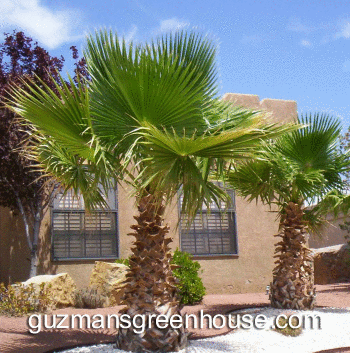
The Mediterranean, California, and Mexican fan palms will survive the southwestern droughts and are seen throughout the southwestern landscape. However, the Mexican fan palm will struggle if temperatures drop into the lower teens, especially newly planted ones.
Palm trees love good, well-drained soil; do not plant them in hard caliche soil. Be sure to ask for a good, composted soil conditioner when purchasing palm trees. All palm trees are in the Arecaceae, or cycads family. Palm Trees of the Southwest Photos.
The Date palm or Phoenix palm also does well in the desert southwest. It typically has one or more large trunks arising from a single root system.
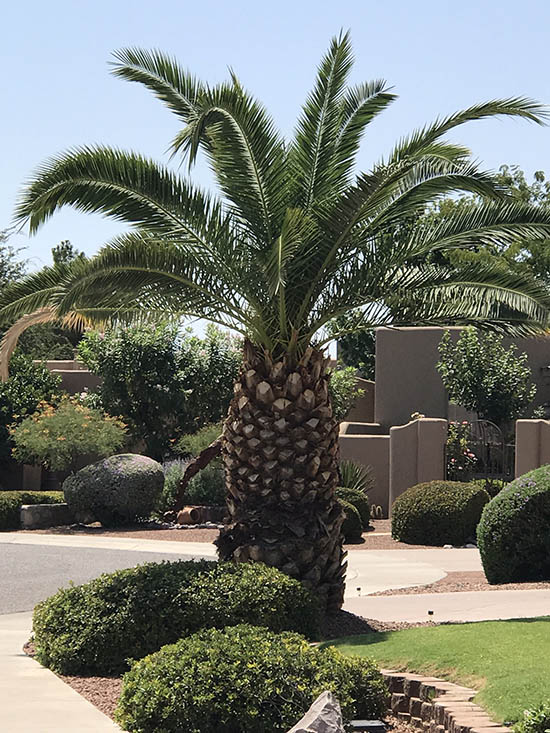
It can grow up to 20- 25 ft. tall. The fronds have a feather-like look to them, long and narrow, perfect for getting moisture from the light sprinkling of rainwater.
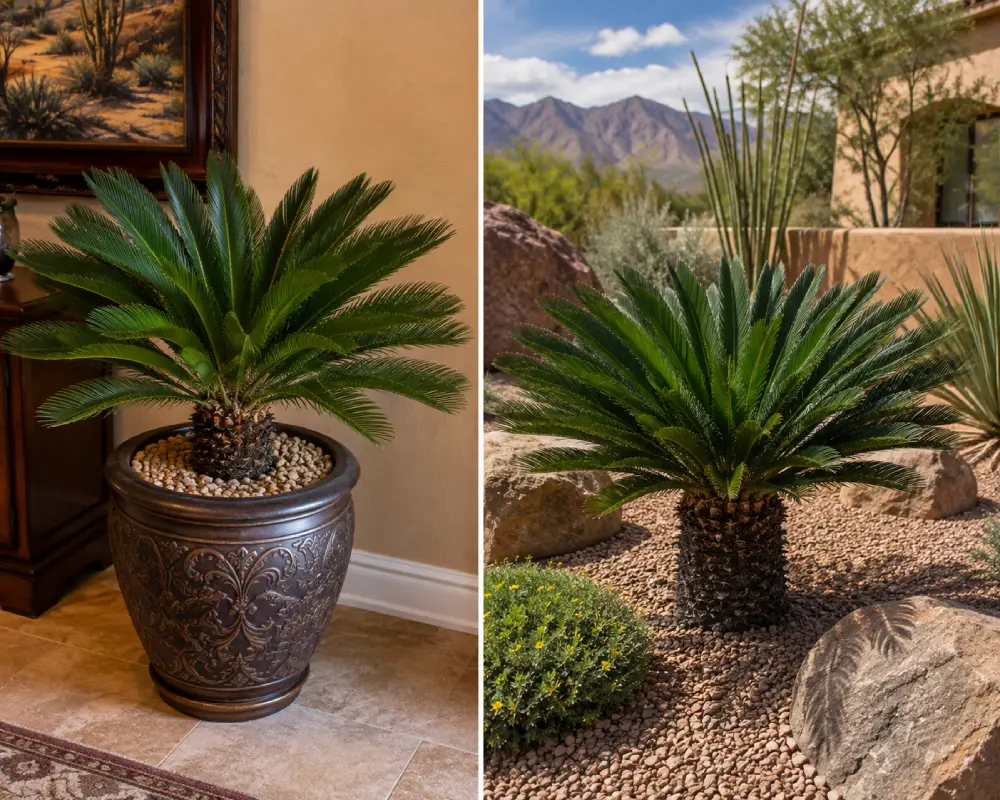
Sago Palm
Care of Palm Trees.
Palm trees thrive in full sun and perform best when grown in well-drained soil with the proper balance of essential nutrients. Unlike many shade trees and shrubs, palms have unique nutritional requirements and benefit from fertilizers that contain manganese, magnesium, sulfur, potassium, and iron. In many landscapes, these nutrients are either lacking or become unavailable over time, especially in alkaline soils common throughout the Desert Southwest.
A quality palm fertilizer with an analysis close to 12-4-12 is an excellent choice because it provides the nutrients palms need to develop healthy roots, strong trunks, and rich green fronds. If you’re planting a new palm, wait a few days after planting before applying fertilizer. This gives the root system time to settle into the surrounding soil and reduces the chance of stressing the newly planted tree.
Established palms also benefit from regular feeding. Fertilizing two to three times a year—typically in early spring, early summer, and again in late summer—helps maintain healthy growth and prevents common nutrient deficiencies, such as yellowing or frizzled leaves. Always follow the application rates listed on the fertilizer label and water thoroughly after applying.
There are hundreds of palm species, and many are remarkably long-lived. While growth rates vary from one species to another, it is not unusual for healthy palms to live well over 100 years, with many species reaching 150 years or more when grown under favorable conditions. Some palms are known to survive for several centuries.
When purchasing a palm tree, be sure to ask for a fertilizer specifically formulated for palms. Products such as Carl Pool’s Palm Food contain the micronutrients that palms require and are an excellent choice for keeping your trees healthy, vigorous, and beautifully green for years to come.
Did you know there are over 2,500 species of palm trees? The Arecaceae family of plants includes wonderfully diverse species found throughout the world, from the desert to the rainforest. Here is a post from mnn.com on some amazing facts about these trees. Facts about Palm Trees.
Care of Palm Trees
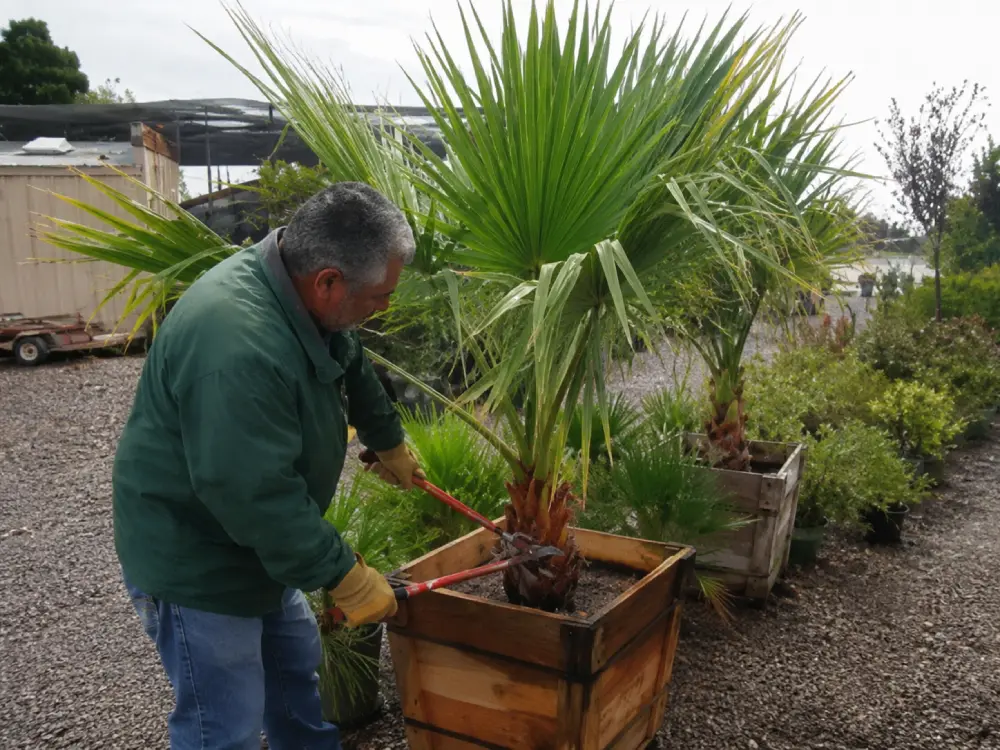
Palms love to be pruned when the fronds start to turn brown or yellow at the bottom. Be sure to wear a good pair of thick gloves before pruning, as the fronds have large, hooked thorns.
Palm Trees are susceptible to Ganoderma Root rot. This is usually caused by too much water, especially in places where there is lots of rainfall. In the Southwest, this is rare, but it does happen.
Check your irrigation system regularly to ensure there are no broken lines, clogged emitters, or leaks that could prevent the palm from receiving adequate water. Avoid planting palm trees directly beneath or too close to rain gutters, where excessive runoff can create overly wet soil conditions and lead to root problems.
Once a palm tree becomes established, typically after 4 to 5 years, watering requirements decrease. During the hot summer months, most established palms only need deep watering once or twice per week. Deep, infrequent watering encourages a stronger root system and helps the tree become more drought-tolerant.
How to Trim Palm Trees
Use good sharp cutting loppers. Corona Clipper 32 ” Professional Bypass Lopper with 2-1/2″ Cutting Capacity is what we recommend.
If your tree is over 15ft. tall, you should call or consult with an arborist or landscaping professional. You should prune fronds at the bottom part of the tree.
If the tree looks brownish at the top, this could be an indication of insects or disease or temperatures below 32 degrees Fahrenheit. Do not use small pruning shears.
Do not cut too close to the trunk, and only trim old browning-type fronds towards the bottom of the tree. Remember, in case of a large over 20ft. or over the tree, you should call or consult with a landscaping professional.
In the Southwest, the Mediterranean and Pindo fan palms are the hardiest, followed by the California, Mexican, Sago, and Windmill palms.
The Mexican palm is taller, up to 100 ft tall, but much narrower. All palms are low water once established. Be sure to remove and dispose of fronds in a large container; you do not want children or pets close to these vicious-type thorns.

Dig your hole twice as wide and about the same depth; see the photo to the left. About 4′ wide and 3′ deep. Planting a palm tree is basically the same as other types of trees. How to plant a tree post here.
The difference between many palm trees in and around the Southwest.
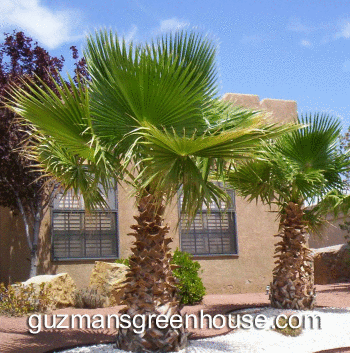 The photo to the left is what a good California fan palm should look like.
Here is a post on Mediterranean palm trees.
Remember, proper palm tree care, pruning, fertilizing, and maintenance will make your landscaping yard a place to be noticed.
Care of Palm trees requires constant observation and following through with fertilizing, trimming, and proper watering.
If you need any type of advice concerning landscaping, gardening, or tree help, do not hesitate to contact us. Article by: Paul Guzman