Last updated on December 27th, 2025 at 08:51 am
Trumpet vines are like that friend who’s fun, loud, and a little bit wild. Gorgeous, full of energy, attracts a crowd (hummingbirds!)—but if you don’t set boundaries early, they take over everything. How to Care for Trumpet Vines. Trumpet vines do well in and around the Southwest region of the U.S.
Here’s a casual, step-by-step guide to caring for trumpet vines so you get all the beauty without the backyard chaos. Trumpet vines are also called trumpet creepers.

Step 1: Pick the Right Spot
Before you even buy the plant, choose a place where it can go big.
- Full sun is best – Aim for at least 6–8 hours of direct sunlight. They’ll survive in partial shade, but you’ll get fewer blooms.
- Give it something sturdy to climb – A strong trellis, arbor, chain-link fence, or masonry wall is ideal. Avoid flimsy wooden fences or small lattices; trumpet vines get heavy.
- Keep it away from structures you care about – The roots and shoots can sneak into cracks, siding, and gutters. Don’t plant it right against your house, septic system, or delicate stucco.
Tip: Think of trumpet vine as a feature plant, not a “cute little filler.” Give it room for it to grow.
Step 2: Prepare the Soil & Plant It
Trumpet vines are not fussy, which is both a blessing and a warning.
- Dig the hole
- Make it about twice as wide as the root ball and roughly the same depth.
- Loosen the soil
- Break up the bottom and sides so the roots can spread.
- If you have super-heavy clay, mix in some compost to improve drainage.
- Set the plant
- Place the root ball in the hole so the top is level with the surrounding soil.
- Backfill
- Refill the hole with the loosened soil, pressing gently to remove big air pockets—but don’t stomp it into concrete.
- Water deeply
- Give it a slow, deep soak to help settle the soil around the roots.
Good news: Trumpet vines tolerate poor soil. You don’t need fancy mixes or rich, heavily fertilized ground. In fact, too much fertility = more leaves, fewer flowers.
Step 3: Watering – Especially That First Year
Trumpet vines are drought-tolerant once established, but baby plants still need regular drinks.
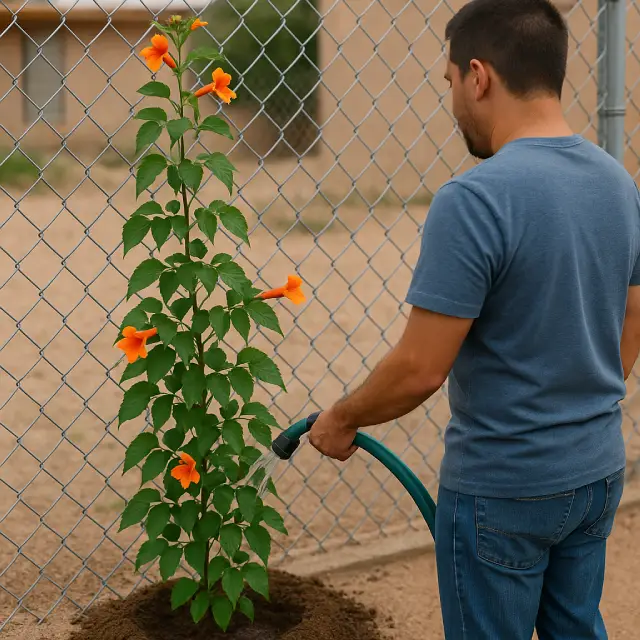
- First year:
- Water deeply about 2–3 times per week, depending on your heat and soil.
- Let the top inch or two of soil dry between watering, but don’t let it bake bone-dry all the time.
- After being established (2–3 years):
- You can usually cut back to 2 or 3 times per week with occasional deep watering, especially if you’re in a region that gets some summer rain.
- In very hot, dry climates, give a deep soak every 7–10 days during peak heat to keep it happy and blooming.
Observe the Trumpet vine in the first year
- Drooping, dull leaves? It might be thirsty.
- Yellowing leaves with soggy soil? You’re overdoing it.
Step 4: Give It Strong Support & Train It Early
If you plant it and walk away, trumpet vine will decide its own path—which usually means “everywhere.”
- Install support from day one
- Trellis, wire, chain link fence, or arbor should be in place before the vine really kicks into gear.
- Tie young stems loosely
- Use soft ties, twine, or old pantyhose (seriously, they work great) to guide stems toward the support.
- Choose a main framework
- Pick a few main stems and encourage them to climb and spread out. Remove weak or awkward stems at the base.
As it grows, keep guiding it where you want it. Think of yourself as the traffic controller for vines.
Step 5: Fertilizing (Less Is More)
Trumpet vines usually do not need much fertilizer, if any.
- If your soil is average, you can skip fertilizer completely.
- If your soil is super poor and sandy, work in some compost once a year in spring around the base of the plant.
Avoid high-nitrogen fertilizers (like lawn food). These encourage lush green foliage and fewer blooms, which defeats the purpose of a flowering vine.
Step 6: Pruning – The Real Secret to Keeping It in Line
Pruning is where you either stay in charge or let the trumpet vine run the show.
When to prune
- Best time is late winter or very early spring, before new growth starts.
- You can also do light cleanup pruning during the growing season if it gets messy.
How to prune
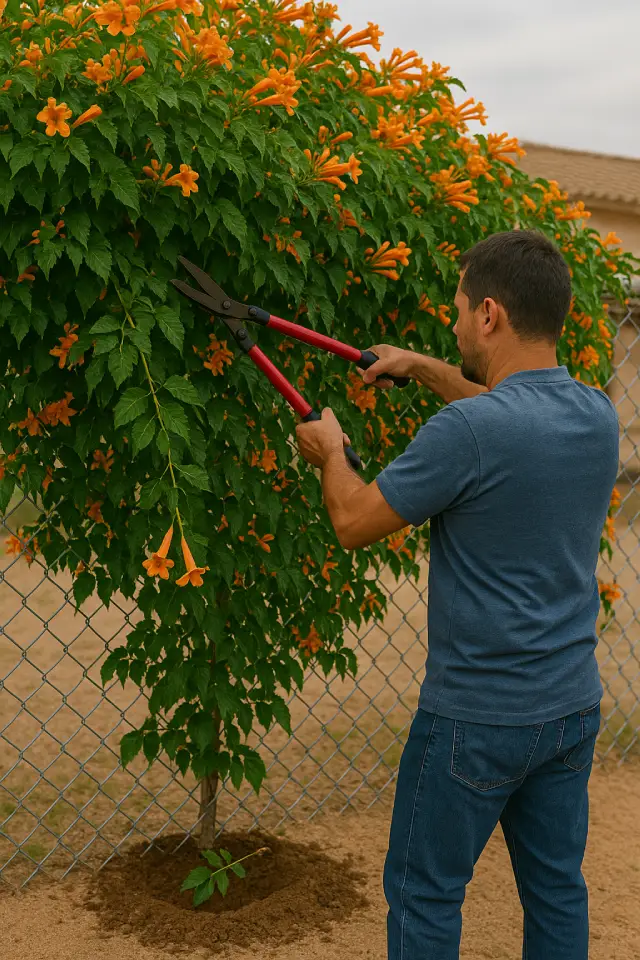
- Start with the dead stuff
- Cut out any dead or damaged stems.
- Shorten long, wild shoots
- You can cut stems back hard—trumpet vine is tough and will bounce back.
- Shape the plant
- Keep the main framework and remove extra shoots that are going in the wrong direction or crowding the structure.
Controlling suckers
Trumpet vines love to send up suckers from their roots.
- Pull or dig them out when they’re small.
- Mulch around the base to make suckers easier to spot.
- Never ignore them, thinking “I’ll deal with it later.”
Step 7: Seasonal Care – Year-Round Checklist
Spring
- Do your major pruning before new growth.
- Check supports and ties.
- Add a light layer of compost if needed.
Summer
- Water deeply but not constantly.
- Enjoy the blooms and hummingbirds!
- Trim back any runaway stems that are invading other plants or structures.
Fall
- Remove seed pods if you want to reduce self-seeding.
- Lightly tidy up any tangled stems.
Winter
- In colder regions, the top growth may die back, but the roots often survive and regrow in spring.
- In milder climates, it may stay partly evergreen; prune in late winter as usual.
Step 8: Common Problems & Quick Fixes
- Lots of leaves, few flowers
- Too much shade or too much fertilizer. Move it to a sunnier spot if possible, and cut back on feeding.
- Taking over the yard
- Prune harder in late winter.
- Remove suckers consistently.
- No growth at all in the first year
- Trumpet vines sometimes “sleep” the first year while establishing roots. Be patient and keep watering deeply, not daily.
🌿 Trumpet Vine FAQ (Southwest Gardening)
1. Are trumpet vines invasive?
Yes — trumpet vines (Campsis radicans) can become invasive if not controlled. They spread by roots, runners, and seeds. Regular pruning and removing suckers will keep them manageable.
2. Do trumpet vines grow well in the Southwest?
Absolutely. They thrive in hot, dry climates and love full sun. Once established, they tolerate drought and poor soils common in New Mexico, Arizona, and West Texas.
3. How much sun do trumpet vines need?
They perform best in full sun (6–8+ hours daily). They will grow in partial shade but produce fewer flowers.
4. How often should I water a trumpet vine?
- First year: Deep water 2-3 times per week.
- After establishment, water thoroughly every other day in extreme heat.
5. How do I control trumpet vine spread?
- Prune heavier every winter
- Remove suckers as soon as they appear
- Do NOT plant near foundations, stucco, or septic lines
- Consider using a root barrier if space is limited
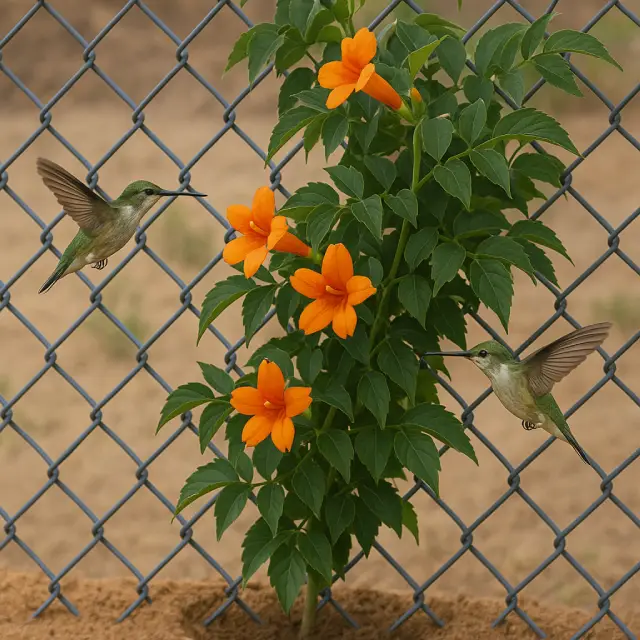
6. Will trumpet vines attract hummingbirds?
Yes — their tubular orange flowers are a hummingbird magnet, especially in the Southwest.
7. What kind of support does a trumpet vine need?
A sturdy structure:
- Chain-link fences
- Metal arbors
- Masonry walls
- Heavy trellises
Do not use flimsy wooden lattice — vines become heavy.
8. When is the best time to prune trumpet vines?
Prune in late winter or very early spring before new growth begins. Light pruning can be done anytime during the growing season.
9. How fast do trumpet vines grow?
Very fast. They can grow several feet per season, especially once established. Pruning keeps them in check.
10. Can trumpet vines grow in gravel or poor soil?
Yes — they’re not picky. They tolerate poor, sandy, or rocky soils as long as they drain well. Avoid heavy over-fertilizing because it reduces blooms.
🐶🐱 Toxicity to Cats & Dogs
-
Not listed as toxic to cats or dogs by the ASPCA
-
Considered generally safe for pets
⚠️ Important notes for pet owners:
-
Ingesting large amounts of leaves or flowers may cause mild stomach upset
-
Sap can cause skin irritation in sensitive people (and occasionally pets)
-
Best planted away from high-traffic pet areas
⚠️ Extra Considerations
-
Very vigorous and invasive in some regions
-
Can damage fences, stucco, and siding if not maintained
-
Requires regular pruning to keep in bounds
-
Attracts hummingbirds and pollinators 🐦
Quick Summary Box (Optional)
-
Zones: 4–9
-
Sun: Full sun
-
Water: Low once established
-
Pet Toxicity: ❌ Non-toxic to cats & dogs
-
Growth Habit: Aggressive climber
Learn more about Southwestern vines for Landscaping.
More information on Trumpet Vines with Wikipedia.

Greenhouse Manager, Master Gardener, and Webmaster.
If you have any questions or enjoyed this post, feel free to share your thoughts in the comments below.