
Last updated on February 15th, 2026 at 12:30 pm
Texas Sage (Leucophyllum spp.) is one of the most beloved shrubs for Southwest landscapes. Heat-tolerant, drought-resistant, and covered with purple blooms after rainfall, it’s ideal for Las Cruces, El Paso, and other desert regions.
For more drought tolerant shrubs that thrive in desert gardens, see our full guide to
Best Shrubs for Southwest Landscapes (Heat & Drought Tolerant Guide).
Why Texas Sage is Perfect for Southwest Gardens
Explain these key benefits:
-
Deep heat tolerance
-
Excellent drought resistance
-
Handles alkaline soils
-
Attracts pollinators
-
Low maintenance once established
Learning how to grow and care for Texas Sage the right way will help you build a beautiful, low-water garden that thrives in harsh summer heat.
Sun and Soil Requirements
H2: Full Sun Exposure Required
-
6+ hours of direct sun
-
Avoid heavy shade
Soil Preferences
-
Well-draining soil
-
Sandy or gravelly soil OK
Watering Texas Sage in the Desert
-
New plants require regular deep watering
-
Once established: water less often
-
Use drip irrigation
-
Avoid overhead watering
-
Adjust frequency by season
When and How to Prune
-
Light pruning after bloom cycles
-
Avoid heavy summer pruning
-
Cut back leggy stems
-
Remove dead wood
Common Problems & Solutions
Overwatering
-
Leads to root rot
Poor Soil Drainage
-
Causes yellowing
Pests and Diseases
-
Rare — occasional aphids
Best Uses in Your Southwest Landscape
-
Xeriscape borders
-
Accent plant
-
Foundation planting
-
Privacy screens
Types of Texas Sages
Green Cloud Sage
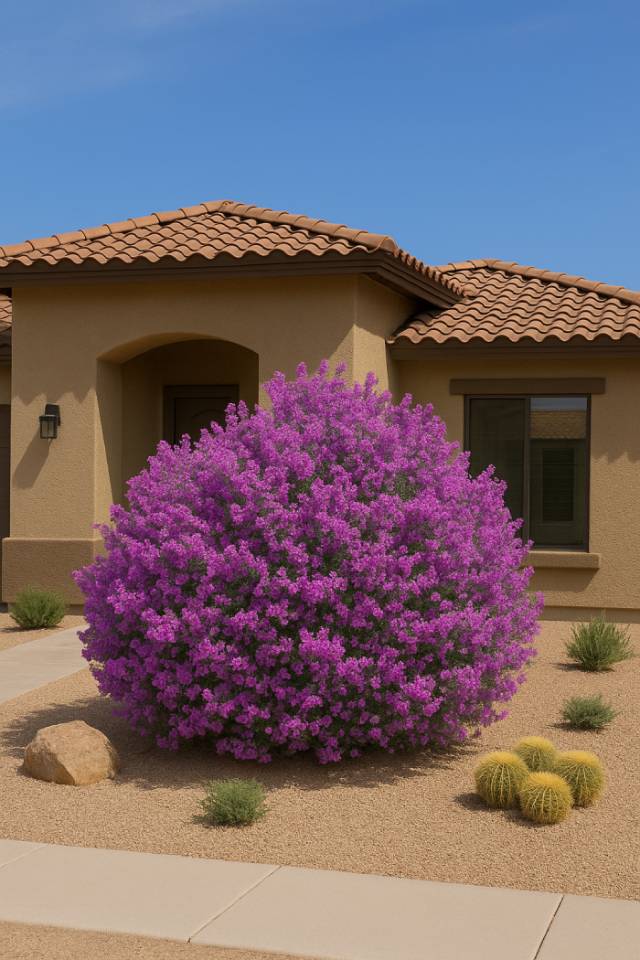
The most common is the Green Cloud Sage (Leucophyllum frutescens) a large evergreen, drought-tolerant shrub well adapted to the Southwest heat. It can grow to about 7-10 ft tall and about the same in width.
Many southwestern cities use these shrubs as a good Xeriscape design landscape. They are durable, hardy, and easy-care plants. The blooms are bright dark purple and will usually bloom during the Monsoon season. The foliage is a bright green color, thus its name.
You can use them as hedges or stand-alone plants. They love the full hot sun…and once established, are drought resistant. All Leucophyllum plants need plenty of water when first planted. They do tolerate poor soil, but will grow faster and provide more blooms with good,d well-composted soil.
Texas Sage Bushes

Texas sage varieties
RIO BRAVO® TEXAS RANGER Leucophyllum langmaniae ‘Rio Bravo’®
Green-Gray foliage. Blooms at branch tips with iridescent violet-blue flowers. Repeats through the warmest months. Forms a dense, uniform shrub that requires no pruning. Loves the southwestern heat, and will do great around driveways and parking lots—a tough low-maintenance native plant – popular as an informal hedge in the southwest. Evergreen shrub. Full sun. Fast growth to 5 feet tall and wide.
Learn more about Texas Sages at Wikipedia.
CIMARRON ® TEXAS RANGER Leucophyllum zygophyllum Cimarron ®
The shorter type of Texas Sage, this tough shrub is perfect for smaller low hedge plantings, a Very drought-tolerant shrub that can be used with other southwestern-style plants and trees. Blooms often and profusely and is less prone to root rot. Compact, rounded shrub to about 3 ft. tall and wide.
It is best to plant them in full sun. They will do great in a xeriscape or rock garden landscape. Texas sages require little maintenance and do NOT overwater.
Search for more photos of this sage at Monrovia.com
The White Texas Sage Bush

COMPACT TEXAS SAGE
Leucophyllum frutescens ‘Compactum’
As the name suggests (compact) it is a smaller sage. It has silver-gray foliage backed with orchid-like pink blooms from summer into fall. Compact means small and has a rounded evergreen shrub useful for clipped hedges and borders. Tolerates drought and poor soil. This sage is a disease and insect-resistant sage, do not overwater. Loves the full Southwestern sun. Moderate grower to 3 to 5 feet tall and wide.


Nice photo of a Green Cloud Sage – (Leucophyllum frutescens), a good-looking sage that does well in the Southwest. This will grow about 8 to 10 ft. wide. See the Photo Below.
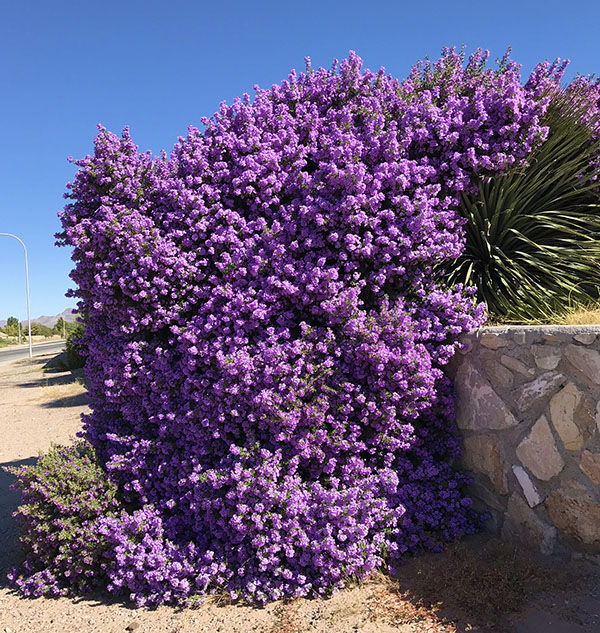

Color Your World Nurseries will usually have this type of plant year-round. Ask for it at your local retail greenhouse or nursery. (Subject to availability)
Care of Texas Sage Bushes
Even the most skilled gardeners can face some challenges when growing Texas Sage. But fear not, because I am here to share some tips and tricks to overcome the problems you might encounter with this magnificent plant.
One common issue that gardeners face with Texas Sage is root rot. This can occur when the soil is not well-drained or if the plant is overwatered. But worry not, my fellow gardeners!
The solution is simple – ensure that you are planting your Texas Sage in well-draining soil and avoid overwatering. You can prevent root rot and keep your Texas Sage thriving by providing proper drainage and allowing the soil to dry out between waterings.
Another challenge that you might encounter with Texas Sage is powdery mildew. This fungal disease can cause a white, powdery coating on the leaves of your plant, making it look unsightly. But fear not, my friends, because there are ways to combat this pesky problem!
One effective method is to ensure that your Texas Sage is planted in an area with good air circulation. You can also use a fungicide specifically designed to treat powdery mildew. By taking these preventive measures, you can keep your Texas Sage looking healthy and vibrant.
In conclusion, the Texas Sage bush is a stunning plant that can bring joy to any garden, but it does come with its fair share of challenges. By following these tips and tricks, you can overcome the problems that you might encounter with Texas Sage and enjoy its beauty year-round. So get out there, grab your gardening tools, and let’s conquer those challenges together! Pictures of Texas Sage Bushes
Texas sage is one of the most reliable desert evergreen shrubs for Southwest landscapes.
Our Blog: View or post a comment below.

Greenhouse Manager, Master Gardener, and Webmaster.
If you have any questions or enjoyed this post, feel free to share your thoughts in the comments below.
can I plant it now ….the purple plant and do you have some thank you
Yes, you can plant it now Josie. Just make sure to water it only a daily basis. Morning are the best time to water. We have several varieties of the Texas sages in stock.
Do you sell Rio Bravo Sage? When is it available and do you ship to Texas?
Hello Mark, we do sell the Rio Bravo sage, however, we do not ship to Texas. You can try to purchase one by following this link. The Rio Bravo sage comes from Monrovia Wholesale nurseries. It is not currently on sale.
Can I purchase Texas white sage? Deliver to Texas?
Sorry but we do not have the White Texas sage. And we do not deliver plants out of our city.
I have been told – and I confirmed this with a Google search- that Texas Sage is “critter proof”. But something has eaten mine almost totally down to the ground. Any advice? Any idea what would be eating them?
Hello, Tanya. I believe the tiny black caterpillar May be he culprit. Look closely at your sages for a small black caterpillar.
Please let me know what you find?
Ok. Thank you. I’ll check. I have also purchased a night vision trail camera to watch them as well.!! I’ll keep you posted.
Ok, Thanks for letting me know.
We would like to have six compact Texas sage bushes planted in replace of our rose bushes.
Can you please provide a quote?
frabert340@gmail.com
Hello, Fred. We do have compact Texas Sages but at this time we do not offer to deliver or plant them.
You can call 575 521-0496 or 575 523-1520 and ask for a price on the 5 gallons compact Texas sage costs.
You will have to find a landscaper or yard maintenance company to help you deliver and plant them.
We can give you a list of landscapers or persons who can also help your with your planting needs.
Thanks for your time and patience.
how to start new plants from existing green cloud sage?
Hello, Tony. Prune off a 4″ stem from the Texas sage right after the last bloom typically in late October or early November. Cut the stem at an angle and split the bottom of the stem with sharp scissors or a razor blade. Dip the cutting in water with root hormone (use a clear glass container to see roots grow). Wait until you get some small fibers or roots at the end of the cutting usually around 3 weeks or so. Then Plant in a well-draining pot with loose potting soil or even cactus mix will work. Water about once per week during the winter months. More often once spring comes around. For better growth bring the plant indoors during the mid-winter months.