Last updated on July 20th, 2025 at 11:53 am
If you live in the Southwest, you know it gets dry and hot during the long summer months. Trees that need a lot of water have a hard time growing in and around the Chihuahuan Desert. The Life Expectancy of Drought Trees is a question you should ask yourself before purchasing a Drought-tolerant tree at your local Nursery store.
You should look for kinds that can handle drought. I like the desert willow, mesquite, and palo verde trees for landscaping in the Desert Southwest. Once they become well established, they grow well with little care, and they don’t suck up your water bill.
Mesquite trees (spp) work great for shade, and they even have cool-looking twisted branches. Palo verde trees stand out with their green bark and yellow flowers, plus they hold up in long dry spells. These trees also help cool the space around your home, so you may even run your AC less. If you plant them as seedlings or in a five-gallon container, water them deeply instead of often.
How Long Do Drought Trees Live
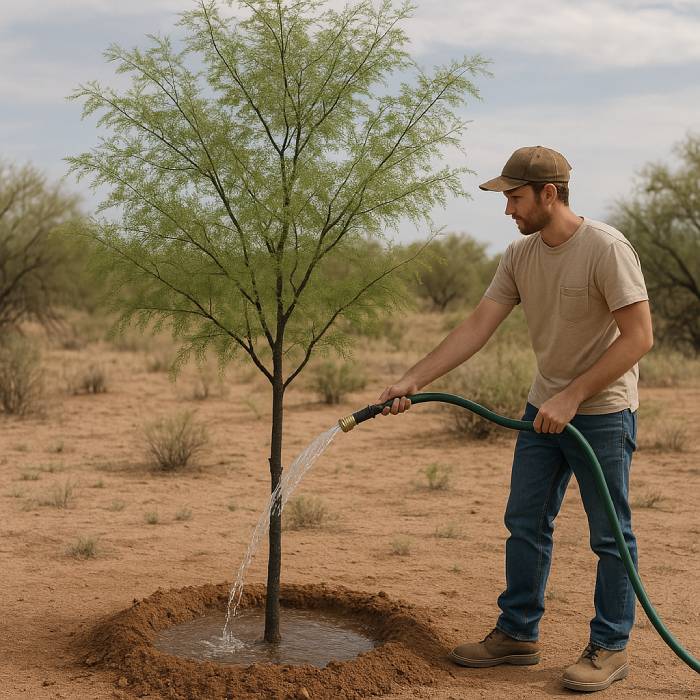
After they have been well established, usually after the third year, water them about once or twice per week. Don’t crowd them with grass or water-hungry plants, or the roots can struggle. You and your neighbors will both like how easy it is to care for them and how they stay green even when most yards turn brown. Pick one that fits your space, give it time, and you’ll get some good shade and color without extra work.
The Life Expectancy of Drought Trees
Texas Red Oak (Quercus buckleyi)
-
Life expectancy: 50–100 years
-
Notes: Smaller than Southern Red Oak; vibrant fall color.
- More Texas Red Oak Information
Desert Willow (Chilopsis linearis)
-
Life expectancy: 20–40 years
-
Notes: Beautiful pink blooms, prefers full sun, low water.
- Desert Willow Tree Pictures.
Palo Verde (Parkinsonia spp.)
-
Life expectancy: 30–70 years. Sometimes much longer, depending on how it’s cared for.
-
Notes: Green bark, yellow flowers, fast-growing in desert climates.
- More on the Palo Verde Tree.
Mesquite (Prosopis glandulosa / P. velutina)
-
Life expectancy: 50–100 years
-
Notes: Thorny, deep taproot, excellent for wildlife habitat.
- More on the Mesquite Trees.
Chinese Pistache (Pistacia chinensis)
-
Life expectancy: 50–150 years
-
Notes: Deciduous, fall color, tolerates heat and drought.
- Chinese Pistache tree for the Southwest
Arizona Cypress (Cupressus arizonica)
-
Life expectancy: 50–150 years
-
Notes: Evergreen, blue-green foliage, tolerates poor soils.
- More on Cypress trees for the Southwest
Live Oak (Quercus virginiana)
-
Life expectancy: 200–300 years
-
Notes: Very long-lived, drought-tolerant once established.
- More on the Live Oak Tree.
Chaste Tree (Vitex agnus-castus)
-
Life expectancy: 20–40 years
-
Notes: Multi-trunked, lavender flowers, low water once established.
- Learn more about the Vitex tree care.
Afghan Pine (Pinus eldarica)
-
Life expectancy: 50–100 years
-
Notes: Fast-growing pine for hot, dry areas.
- Pine trees Southwest
Texas Mountain Laurel (Dermatophyllum secundiflorum)
-
Life expectancy: 40–80 years
-
Notes: Slow-growing, purple wisteria-like blooms, evergreen.
- More information on the Texas Mountain Laurel.
Western Redbud (Cercis occidentalis)
-
Life expectancy: 40–60 years
-
Notes: Small tree, drought-tolerant, showy pink flowers in early spring.
- Types of Rebud Trees for the Southwest USA.
Honey Mesquite (Prosopis glandulosa)
-
Life expectancy: 40–100 years
-
Notes: Fast growth, nitrogen-fixing, excellent drought tolerance.

Chinese Elm (Ulmus parvifolia)
-
Life expectancy: 50–100 years
-
Notes: Tolerates drought and urban conditions, attractive bark.
- An Invasive Tree. Not to be confused with the Siberian Elm.
- Not a good choice for any tree Landscape
Eucalyptus spp. (various species)
-
Life expectancy: 50–150 years (varies by species)
-
Notes: Very drought-tolerant but can be invasive; fast-growing.
- More about this tree at New Mexico Southwest Trees.
Ash Trees (spp)
-
Life expectancy: 30–50 years
-
Notes: Rapid growth, tolerates heat and drought.
- Caring for Ash Trees Southwest
How To Make Your Trees Live Longer
If you want your trees to stick around for years, start with good soil and water them. Drought-tolerant trees should be watered according to the instructions at the top of this article. Mulch is good, but don’t pile mulch up high against the trunk; let it sit a bit away so air can move. Prune off dead or weak branches, but don’t hack away too much at once. Watch for bugs or weird spots on leaves since a lot of trouble starts small. Observe your trees often and act quickly if you see signs of holes on the trunk or foliage completely eaten off.
Keep Trimmers Away from Trunk
Keep string trimmers and lawnmowers away from the bark, since nicks can open up the tree to fungi and pests. If you see roots poking out of the ground, leave them alone. Roots need to breathe, so piling dirt or rocks on top will only stress them out. When you take care of these small things, your trees will thank you with strong branches and green leaves year after year. Do you notice any issues with your trees, or have you found a way to help them grow better? Let us know by commenting below.

Greenhouse Manager, Master Gardener, and Webmaster.
If you have any questions or enjoyed this post, feel free to share your thoughts in the comments below.