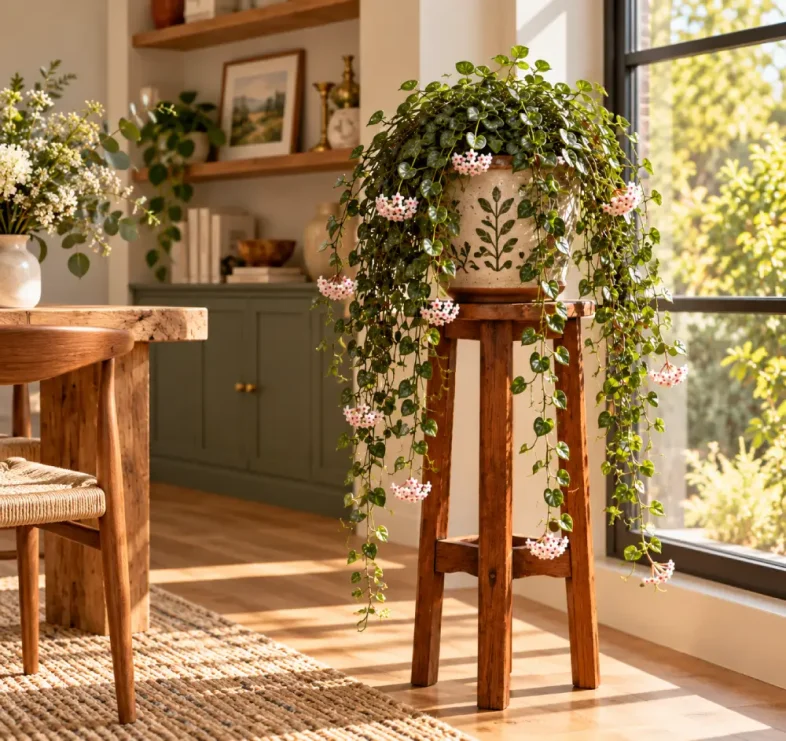
Hoyas have become some of the most popular houseplants around, and it is easy to see why. They have interesting foliage, long trailing or climbing vines, and some varieties produce beautiful clusters of waxy, star-shaped flowers.
If you are looking for a houseplant that is a little different from the usual pothos or philodendron, take a look at the many types of Hoya plants available today.
Hoyas are commonly called wax plants or porcelain flowers because of their thick leaves and unusual wax-like flowers. Some types have large leaves, others have tiny leaves, and a few develop long cascading stems that make excellent hanging Hoya plants.
Here in Las Cruces and throughout the Desert Southwest, Hoyas are primarily indoor plants. Our intense sunlight, extremely low humidity, and cold winter nights mean they need a little protection. However, once you understand what they like, many Hoyas are surprisingly easy to maintain.
What Is a Hoya Plant?
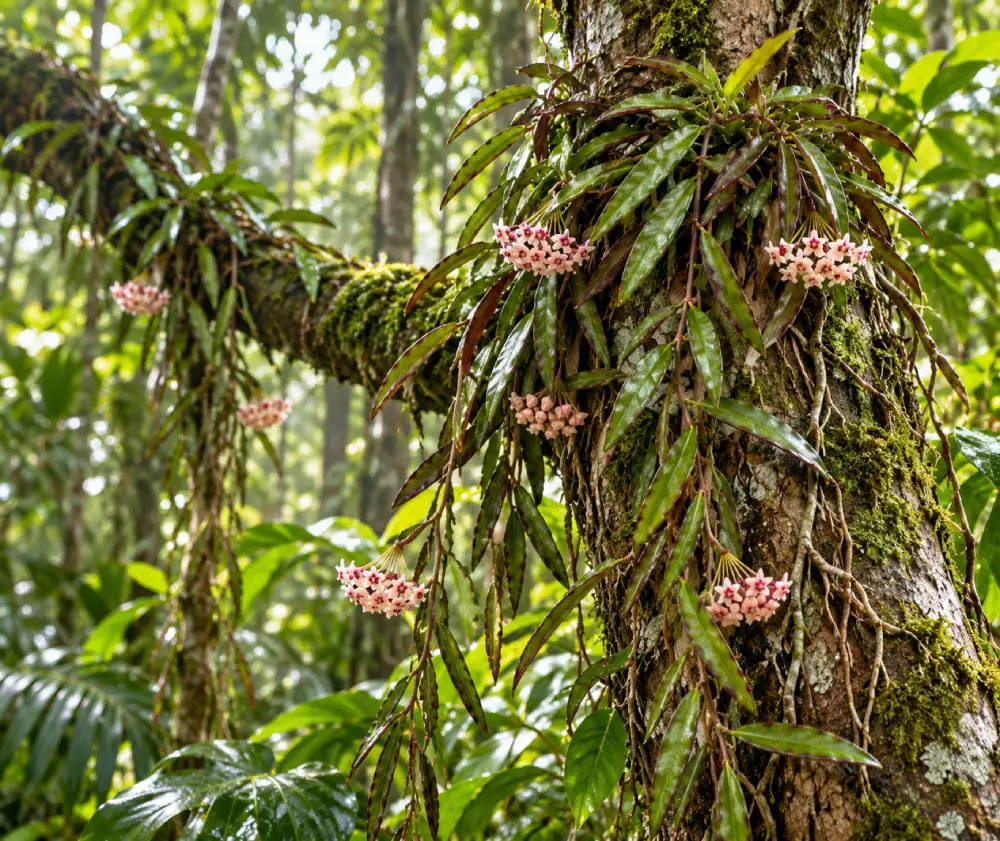
Hoya is a large genus of tropical and subtropical plants native mainly to Asia, Australia, and islands of the western Pacific.
Types of Hoya plants include numerous cultivars and hybrids.
Many Hoyas naturally grow as epiphytes, meaning they grow on trees and other plants without actually taking nutrients from the host plant. Their roots are accustomed to plenty of air and very good drainage.
That tells us something important about growing Hoyas indoors:
Do not plant them in heavy, soggy potting soil.
Hoyas generally prefer an airy potting mixture and would rather become slightly dry between waterings than stay wet continuously.
Most produce vines that can either climb a small trellis or cascade from a hanging container.
And then there are those flowers.
Mature Hoyas can develop clusters of small star-shaped flowers that almost look artificial. Depending on the variety, flowers may be white, cream, pink, red, burgundy, or combinations of these colors. Many are also fragrant, particularly during the evening.
Types of Hoya plants in Southwest Homes
Hoyas actually have several characteristics that make them good houseplants for New Mexico, Arizona, West Texas, and other parts of the Desert Southwest.
Their thick or semi-succulent leaves store some moisture, so they usually don’t require constant watering.
They also appreciate plenty of light.
And we certainly have plenty of sunlight in the Southwest.
The trick is controlling that sunlight.
A bright east-facing window is often excellent. A south- or west-facing window can also work, but during our hotter months the sunlight coming directly through the glass can become intense enough to scorch foliage.
Use a sheer curtain or move the plant farther away from the window if the foliage begins looking bleached, reddish, or scorched.
Hoyas want bright light — not a roasting hot window.
Popular Types of Hoya Plants
There are far too many Hoyas to cover every one, but these are some of the most popular varieties you are likely to encounter.
1. Hoya carnosa – The Classic Wax Plant
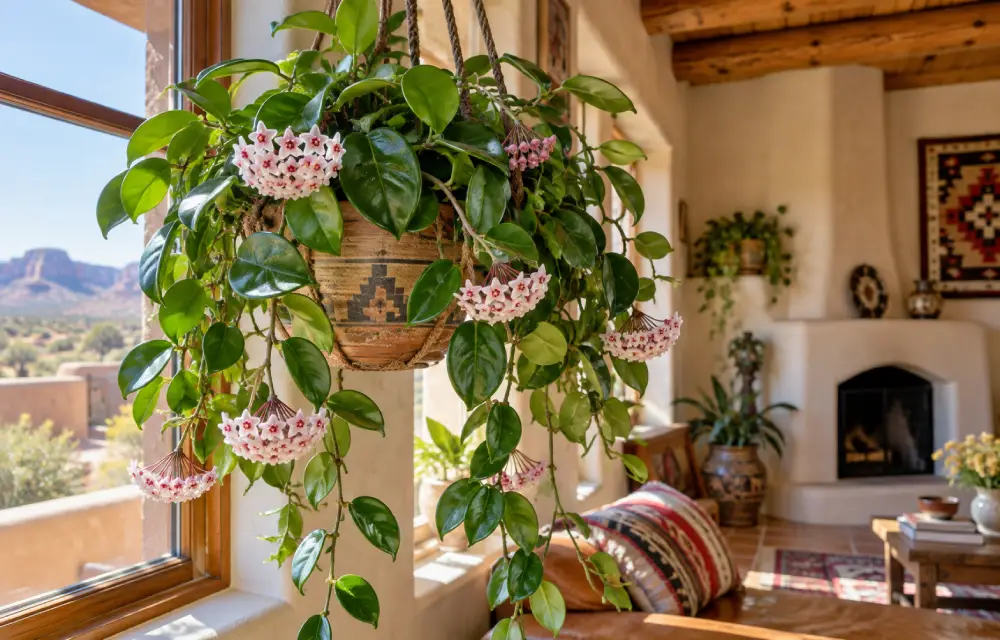
If you are new to Hoyas, Hoya carnosa is an excellent place to start.
This is the traditional wax plant that people have grown indoors for generations.
It produces long vines with thick, dark-green waxy leaves. Once mature, it can produce clusters of fragrant white to pale-pink flowers with darker centers.
Hoya carnosa can be allowed to trail from a hanging container or trained around a small trellis.
It is also one of the more forgiving Hoyas when it comes to indoor growing conditions.
2. Hoya carnosa ‘Compacta’ – Hindu Rope Hoya
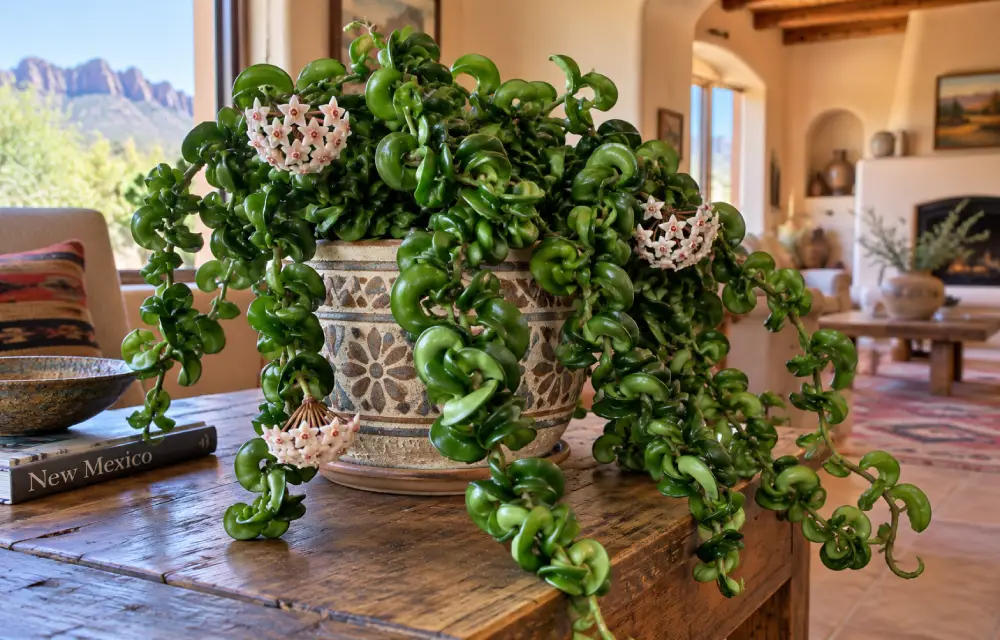
This one is hard to miss.
The Hindu Rope Hoya, sometimes called the rope plant, has thick leaves that curl and twist tightly around the stems.
As the stems lengthen, they begin hanging downward like thick green ropes.
This makes it one of my favorite choices for a hanging basket.
Hindu Rope Hoyas are slower growing than regular Hoya carnosa, so don’t become concerned if your plant doesn’t seem to be doing much for a while.
Given enough light and maturity, it can eventually produce the same type of beautiful waxy flower clusters associated with Hoya carnosa.
3. Hoya carnosa ‘Krimson Queen’
Krimson Queen Hoya is grown as much for its foliage as its flowers.
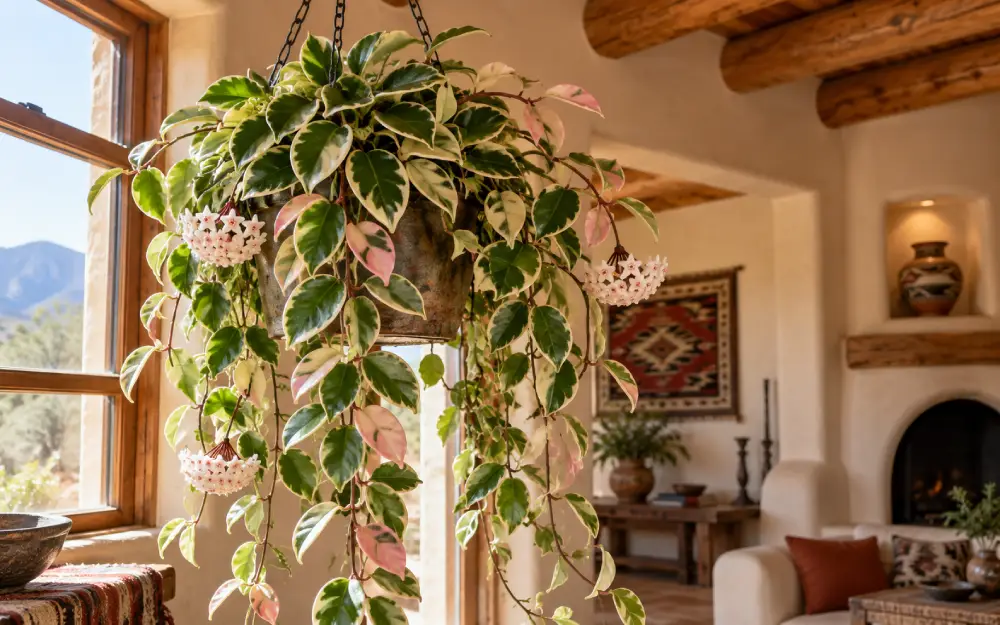
Its leaves typically have green centers surrounded by cream or white margins. New growth can sometimes emerge pink or reddish before maturing.
The long vines look especially attractive hanging from a shelf or decorative container.
Give this plant good bright light to help maintain the variegation.
4. Hoya carnosa ‘Krimson Princess’
Krimson Princess is another beautiful variegated Hoya carnosa.
The easiest way to distinguish the two is by looking at where the variegation appears.
Krimson Queen: lighter color primarily around the outside edge of the leaf.
Krimson Princess: cream or yellow variegation primarily toward the center of the leaf.
Both make excellent indoor plants.
5. Hoya pubicalyx – Silver Pink Hoya
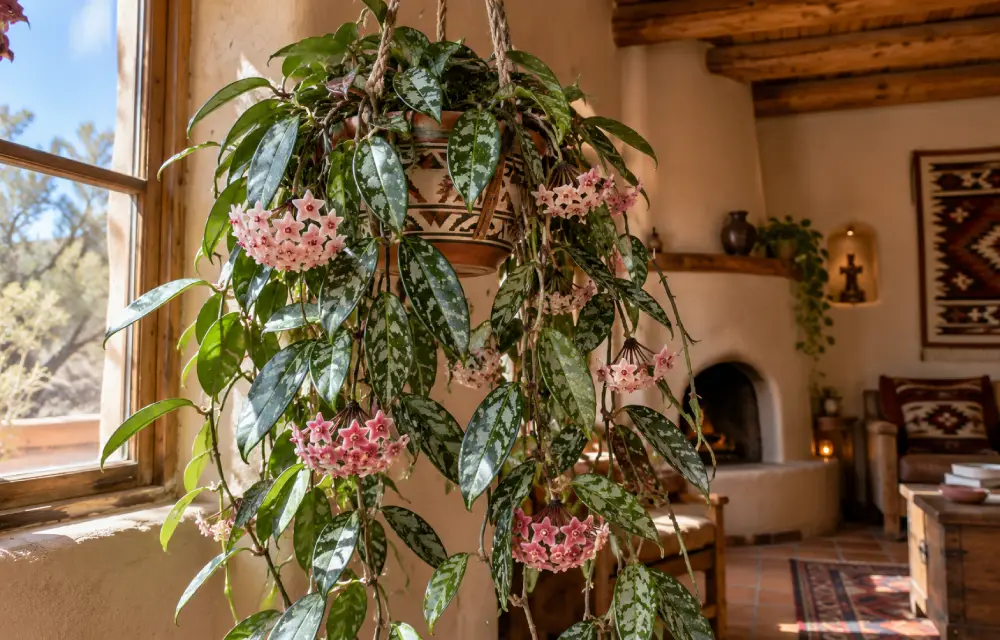
If you want a vigorous Hoya, consider Hoya pubicalyx.
Its long, narrow leaves frequently have silvery flecks or splash-like markings.
It can grow quickly once established and develops long vines that can be trained around a trellis or allowed to cascade.
Flowers can range from pink to deep reddish-purple depending on the variety.
This is another good Hoya for someone who is just getting started.
6. Hoya australis
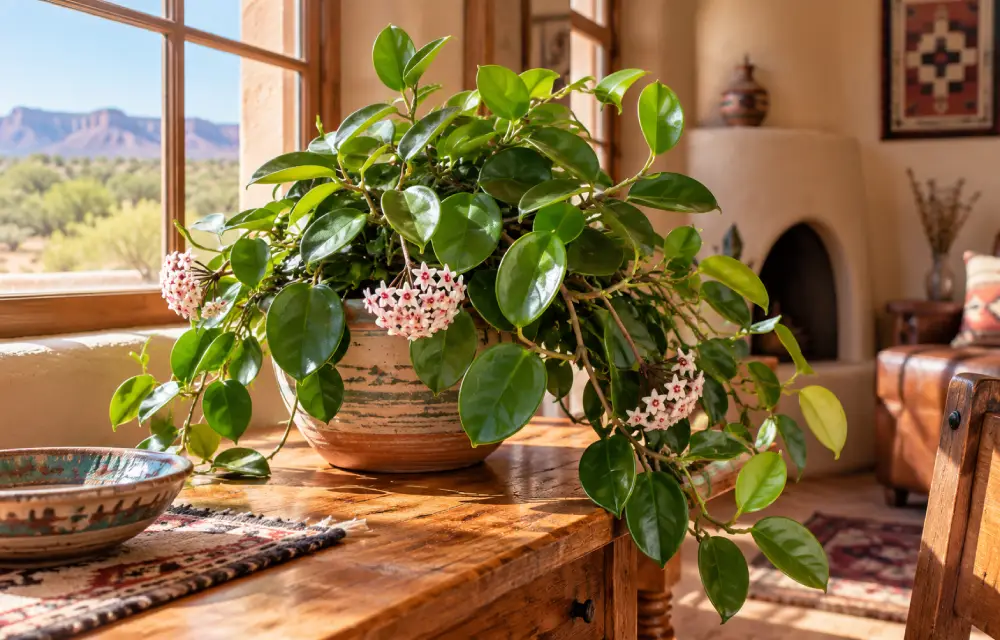
Hoya australis has attractive rounded or oval green leaves and produces vigorous vines.
Its flowers are normally white with pinkish-red centers and can be pleasantly fragrant.
Give it something to climb and it can make an impressive specimen plant.
There are also variegated forms available with cream, yellow, and green foliage.
7. Hoya kerrii – Sweetheart Hoya
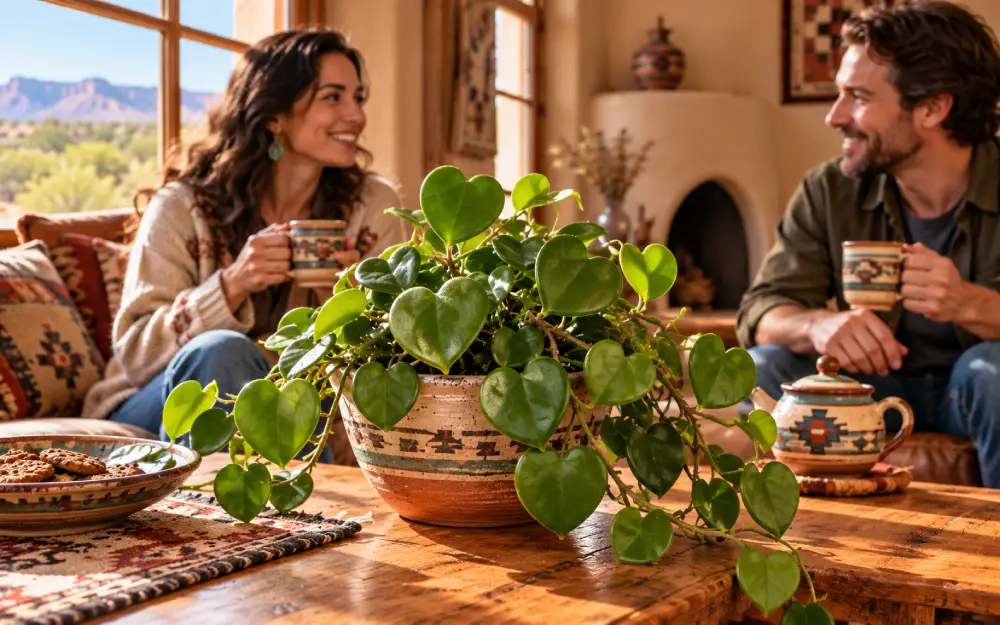
You’ve probably seen this Hoya around Valentine’s Day.
Hoya kerrii, commonly called the Sweetheart Hoya, produces thick heart-shaped leaves along long vines.
But there is something consumers should know.
Many stores sell a single heart-shaped Hoya leaf planted in a small container. It looks cute, and the leaf may remain alive for a long time.
However, if that leaf was propagated without a piece of stem containing a node, it normally will not grow into a full vine.
If you want an actual Sweetheart Hoya plant, look for one that already has a stem and several leaves rather than just one heart-shaped leaf.
8. Hoya obovata

Hoya obovata is easy to recognize because of its large, thick, rounded leaves.
Some plants also develop attractive silver splashes across their green foliage.
The large leaves give this Hoya a completely different appearance from the narrow-leaved varieties.
It can be grown as a climbing plant or allowed to trail.
9. Hoya bella – Beautiful Hoya
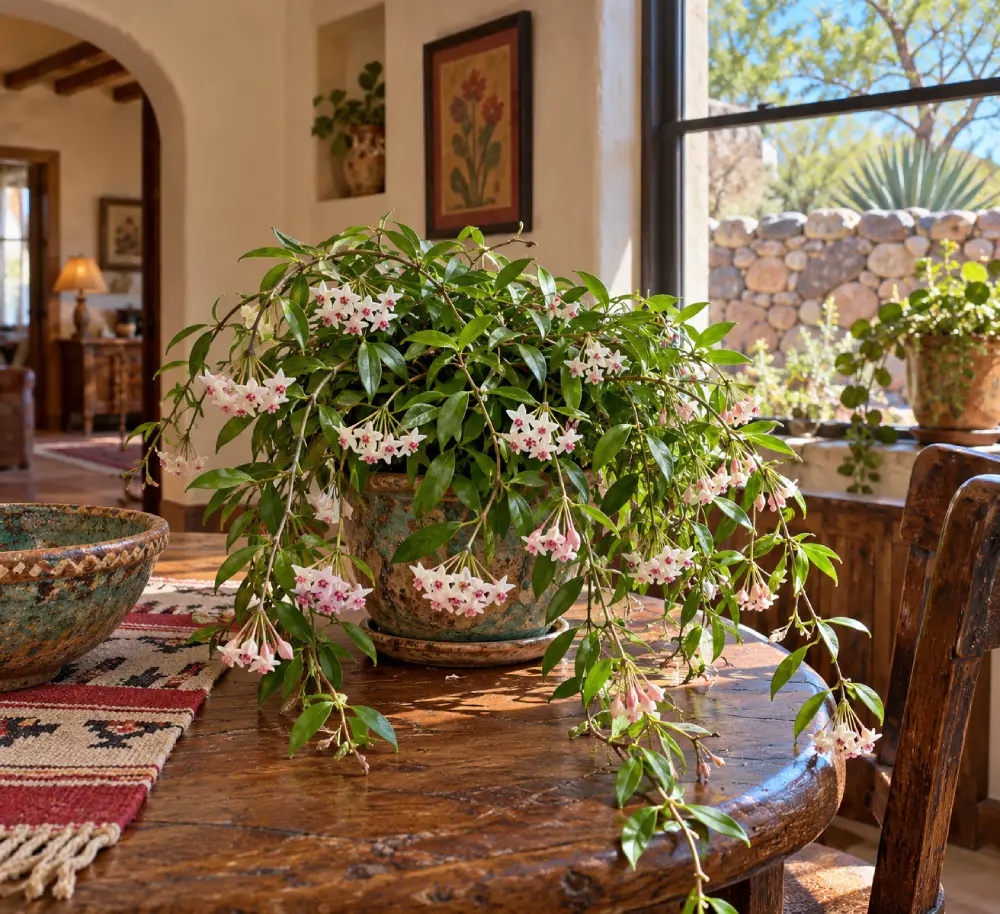
The name fits the plant.
Hoya bella has smaller leaves and thinner stems than many other Hoyas.
Instead of producing large heavy vines, it tends to form graceful cascading growth.
This makes it particularly well suited for hanging baskets.
Its flowers are typically white with pink or purplish centers.
10. Hoya linearis

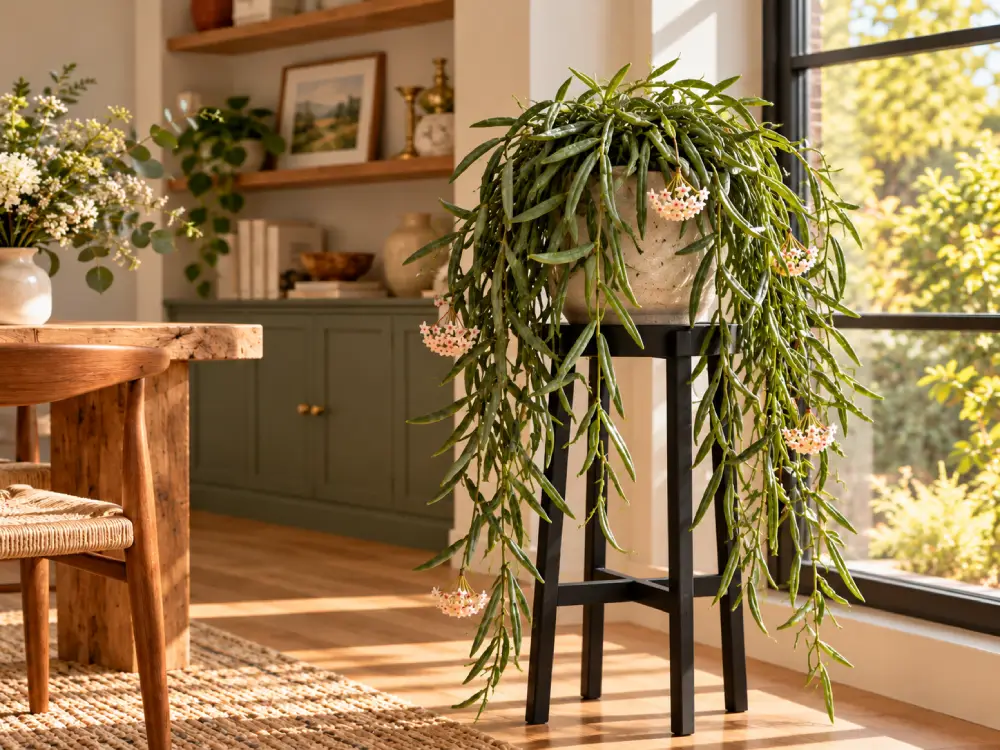
If you want a Hoya that doesn’t look anything like a traditional Hoya, look for Hoya linearis.
It produces long hanging stems covered with narrow leaves.
From a distance it can almost resemble a soft green curtain.
Hoya linearis is particularly attractive hanging from a high shelf or hanging planter where its stems have plenty of room to fall naturally.
The RHS specifically recommends Hoya linearis for hanging planters.
11. Hoya curtisii
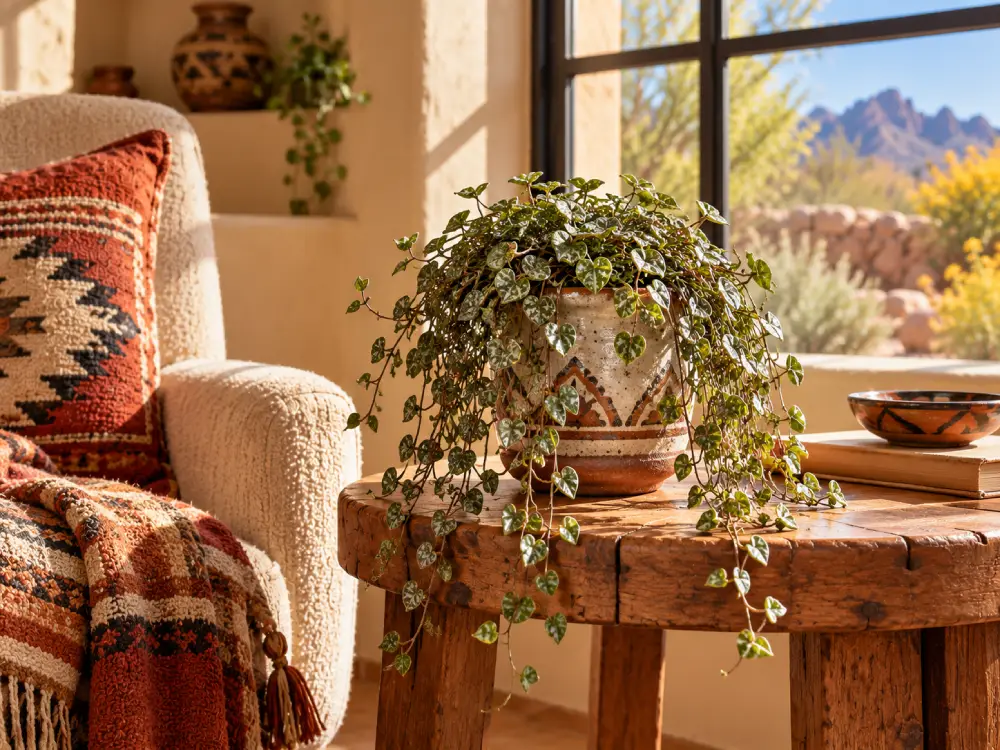
Hoya curtisii is a smaller-leaved Hoya with an excellent trailing habit.
The foliage is usually dark green with attractive silver markings.
Because the leaves are smaller and the stems spread and cascade, this plant looks especially good in smaller hanging containers.
It is a good choice when you want the Hoya look without eventually having an enormous plant.
12. Hoya lacunosa
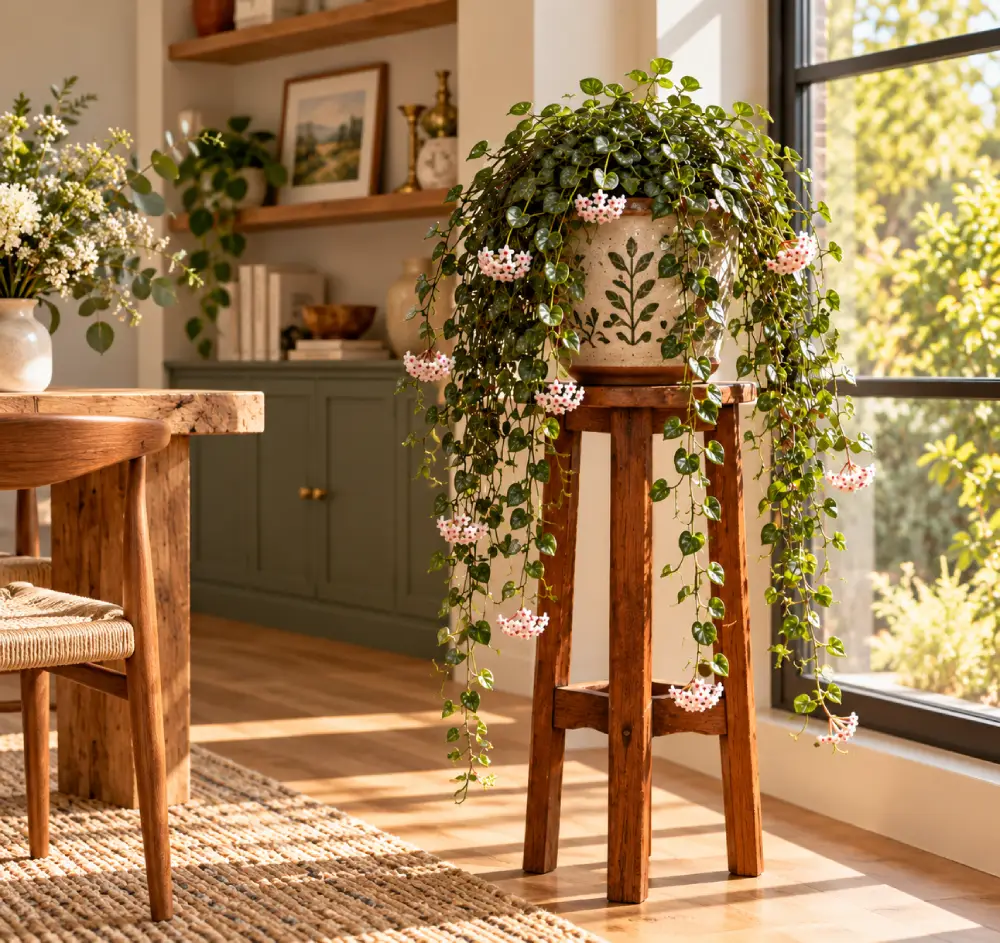
Hoya lacunosa has smaller leaves and a beautiful trailing habit.
It can develop large numbers of small fragrant flowers once mature.
This is another excellent choice for shelves, hanging planters, and areas where you want vines spilling downward.
13. Hoya shepherdii – String Bean Hoya
The leaves explain the name.
Hoya shepherdii produces unusually long, narrow, slightly curved leaves that can resemble green beans.
Its unusual foliage makes it a great choice for collectors looking for something different.
Allow the stems to hang naturally or train them around a support.
14. Hoya wayetii
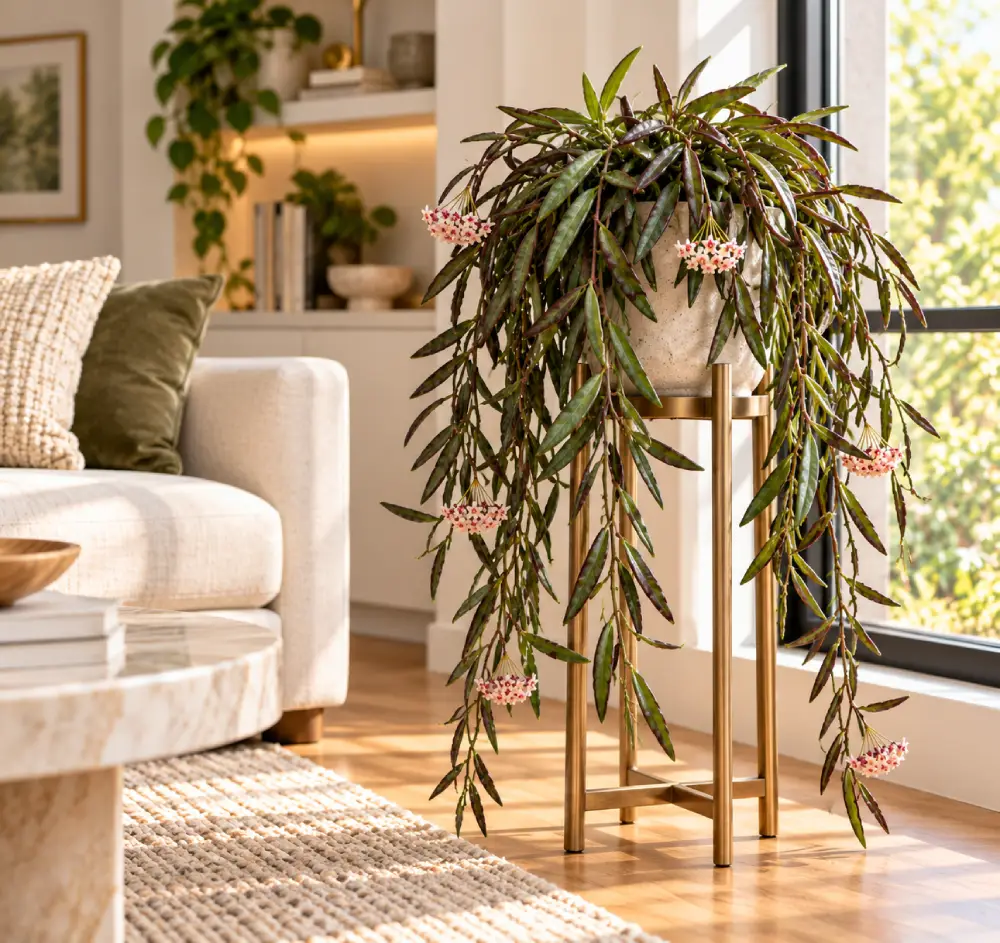
Hoya wayetii has long, narrow leaves that often develop darker margins when exposed to plenty of light.
Its vines look excellent hanging from a basket, particularly after the plant becomes full.
Like most Hoyas, protect it from the intense direct afternoon sunlight we get in southern New Mexico.
What Are the Best Hoyas for Hanging Baskets?
Although many Hoyas can be grown in hanging containers, some naturally look better hanging than others.
My favorites for a hanging Hoya plant are:
- Hoya carnosa ‘Compacta’
- Hoya bella
- Hoya linearis
- Hoya curtisii
- Hoya lacunosa
- Hoya wayetii
- Hoya carnosa
- Krimson Queen
- Krimson Princess
You can also place Hoyas on a tall shelf and let the vines cascade downward.
Just remember that light becomes important.
A beautiful Hoya hanging five feet from the nearest window may survive, but it probably won’t grow or flower nearly as well as one that gets plenty of bright light.
How Much Light Does a Hoya Need?
This is one of the most important parts of Hoya care.
Hoyas generally prefer bright indirect light.
Here in the Southwest, an east-facing window that receives morning sunlight can be excellent.
South-facing windows provide plenty of light but may become too intense during summer.
West-facing windows can be especially hot during June, July, and August.
If your Hoya is sitting next to hot glass with afternoon sunlight beating directly onto the leaves, move it back or filter the sunlight through a sheer curtain.
Not enough light creates another problem.
A Hoya may remain green and alive in low light but never flower.
If you’ve had a healthy Hoya for several years and it refuses to bloom, insufficient light is one of the first things I would check.
How Often Should You Water a Hoya?
Do not water Hoyas according to a strict calendar.
Instead, check the potting mixture.
Allow the upper portion of the soil to dry before watering again. When you do water, water the plant thoroughly and allow excess water to drain from the bottom of the container.
Then empty any saucer underneath it.
Never leave a Hoya sitting in water.
Hoyas have thicker leaves than many tropical houseplants and can handle becoming somewhat dry. Constantly wet roots are much more dangerous.
This is one of those plants where too much attention can create problems.
Don’t love your Hoya to death with water.
During winter, growth usually slows because the days are shorter. The plant will normally use less water, so check the soil carefully before watering.
The Best Soil for Hoyas
Drainage is extremely important.
I prefer an airy mixture instead of regular heavy potting soil by itself.
A good Hoya mixture can contain:
- Quality indoor potting soil
- Orchid bark
- Perlite or pumice
The exact percentages aren’t nearly as important as the result.
You want water to move through the container easily while the mixture remains loose enough for oxygen to reach the roots.
Iowa State Extension recommends a chunky, airy substrate and gives a mixture of potting soil, orchid bark, and perlite or pumice as a good example.
And, of course, your container needs a drainage hole.
Don’t Put Hoyas in Oversized Pots
Hoyas don’t need a huge container.
In fact, they usually perform better when somewhat snug in their pots.
Putting a small Hoya into a large decorative container creates a big mass of wet soil around a relatively small root system.
That soil can remain wet much too long.
When it is time to repot, move up only one container size.
Hoyas can often stay in the same container for several years.
Humidity and Hoyas in New Mexico
This is where our Southwest climate becomes a factor.
Our air is dry outdoors, and indoor heating and air conditioning can make it even drier.
Fortunately, many common Hoyas adapt reasonably well to normal household conditions. Iowa State Extension lists approximately 40 to 60 percent humidity as favorable for good growth and flowering.
If the air in your home is extremely dry, try grouping several houseplants together or using a small humidifier nearby.
A bright kitchen or bathroom can also provide a slightly more humid environment, provided there is enough natural light.
Can Hoyas Go Outside in Las Cruces?
Yes, but be careful.
A Hoya that has spent months inside your home should never be carried outside and placed directly in our Southwest summer sun.
The leaves can scorch quickly.
If you move your Hoya outdoors during warm weather, place it in a bright shaded location, such as a covered patio where it receives filtered light or gentle morning sun.
Gradually acclimate it to outdoor conditions.
And remember that Hoyas are tropical plants.
They are not frost hardy.
Bring them back indoors well before freezing weather arrives. Hoya carnosa, for example, should be brought indoors as nighttime temperatures approach about 50 degrees.
How Do I Get My Hoya to Flower?
This is probably one of the most common Hoya questions.
First, be patient.
Some Hoyas take several years before they are mature enough to flower.
Then provide plenty of bright light.
You should also avoid constantly moving the plant around, especially after flower buds begin forming.
And here’s something very important:
Don’t Cut Off the Old Flower Spurs
Hoyas produce flowers from structures called peduncles, sometimes simply called flower spurs.
After the flowers finish blooming, you may be tempted to cut the little bare spur off.
Don’t do it.
Many Hoyas produce flowers again from that same location.
Cutting the peduncle can remove a future flowering site.
Let the old flowers fall naturally and leave the spur attached.
Fertilizing Hoya Plants
Hoyas aren’t particularly heavy feeders.
During spring and summer, when the plant is actively growing, use a balanced houseplant fertilizer according to label directions.
I prefer going lighter rather than heavier with houseplant fertilizer.
Too much fertilizer can leave salts behind in the potting mixture and damage roots.
During winter, when growth slows considerably, reduce or discontinue feeding until active growth returns.
Should You Trellis or Hang a Hoya?
Either method works.
Some Hoyas naturally look spectacular hanging down, while vigorous climbers may benefit from a small trellis, hoop, or other support.
You can even combine the two.
Train some vines upward around a hoop while allowing others to cascade from the container.
Hoya carnosa, Hoya pubicalyx, and Hoya australis work especially well on supports.
Hoya linearis, bella, curtisii, and Compacta are particularly attractive when allowed to hang.
How to Propagate a Hoya
Hoyas are commonly propagated from stem cuttings.
Choose a healthy stem containing at least a couple of leaves and, most importantly, a node.
The node is the area along the stem where new roots and shoots can develop.
You can root cuttings in a loose propagation mix, perlite, or other well-aerated medium.
Keep the cutting warm and in bright indirect light while roots develop.
And remember our Sweetheart Hoya example: a leaf by itself isn’t necessarily enough.
You need a node if you want a cutting that will eventually develop into a complete vining plant.
Common Hoya Problems
Yellow Leaves
The first thing I would check is watering.
Yellowing leaves combined with constantly wet potting soil can indicate overwatering or poor drainage.
Wrinkled Leaves
Wrinkling may mean the plant has become too dry.
However, don’t automatically add water.
If the soil is already wet and the leaves are wrinkled, damaged or rotting roots may be preventing the plant from absorbing moisture.
No Flowers
The most common possibilities are:
- Not enough light
- Plant is still young
- Container is unnecessarily large
- Too much fertilizer
- Constantly moving the plant
- Cutting off old flowering peduncles
Mealybugs
Mealybugs love Hoyas, particularly the tight spaces around stems and leaves.
The twisted leaves of Hindu Rope Hoya give mealybugs plenty of hiding places, so inspect those plants carefully.
Spider Mites
Spider mites may become troublesome when indoor conditions become extremely dry — something we certainly experience in the Desert Southwest.
Look underneath leaves for tiny pests, stippling, or fine webbing.
Scale
Scale insects can also attack Hoyas.
Check stems and the undersides of foliage for small brown or tan bumps that don’t easily brush away.
Inspect your plants regularly. Finding these pests early makes them much easier to control.
Are Hoya Plants Difficult to Grow?
Most common Hoyas are not difficult.
The biggest mistakes are usually:
Too much water. Too little light. Heavy soil. And pots that are too large.
Give them bright filtered light, excellent drainage, and a chance to dry somewhat between waterings, and many Hoyas will grow for years.
They are also good plants for people who enjoy something unusual.
Some varieties are grown mainly for their flowers. Others are worth growing simply because the foliage is so interesting.
And if you like hanging plants, Hoyas offer some of the best choices available.
Which Hoya Should You Start With?
For someone buying their first Hoya, I would start with one of these:
Hoya carnosa – dependable and relatively easy.
Hoya pubicalyx – vigorous with attractive foliage.
Krimson Queen – excellent if you like variegated leaves.
Hoya carnosa Compacta – perfect if you want a hanging Hoya that really stands out.
Once you’ve successfully grown one Hoya, don’t be surprised if you start looking for another variety.
There are enough different leaf shapes, colors, vines, and flowers to make collecting Hoyas rather addictive.
For gardeners in Las Cruces and throughout the Desert Southwest, just remember the basics: protect them from our intense afternoon sun, use a fast-draining potting mixture, don’t overwater, and keep them indoors when cold weather arrives.
Do that, and your Hoya may eventually reward you with those beautiful waxy flowers that make these plants so distinctive.
Frequently Asked Questions About Hoya Plants
Are Hoyas good hanging plants?
Yes. Many Hoyas naturally produce trailing vines and are excellent choices for hanging baskets. Hoya Compacta, Hoya bella, Hoya linearis, Hoya curtisii, and Hoya lacunosa are especially attractive when allowed to cascade.
Do Hoyas like direct sunlight?
They like very bright light, but intense direct afternoon sun can scorch the foliage. This is especially important in New Mexico and the Desert Southwest, where south- and west-facing windows can become extremely hot.
How often should I water my Hoya?
Don’t use a fixed schedule. Check the potting mixture and allow it to dry somewhat before watering thoroughly again.
Do Hoyas like small pots?
Hoyas generally don’t mind being somewhat root-bound. Avoid moving a small plant into an oversized container because the extra soil may stay wet too long.
Why isn’t my Hoya flowering?
Insufficient light is one of the most common reasons. Age also matters because young Hoyas may need several years before flowering.
Should I cut the dead flowers off a Hoya?
Let the flowers fall naturally and leave the old flower spur or peduncle attached. Many Hoyas bloom repeatedly from these same structures.
Can Hoyas live outdoors in New Mexico?
They can spend some warm-weather time outdoors in bright shade or filtered sunlight, but they are tropical plants and cannot tolerate our freezing winter temperatures
More information about Hoyas below.
Yard and Garden Iowa State Extension — All About Hoyas Penn State also published an updated Hoya houseplant guide in August 2026. Penn State Extension Penn State Extension — Hoyas as Houseplants
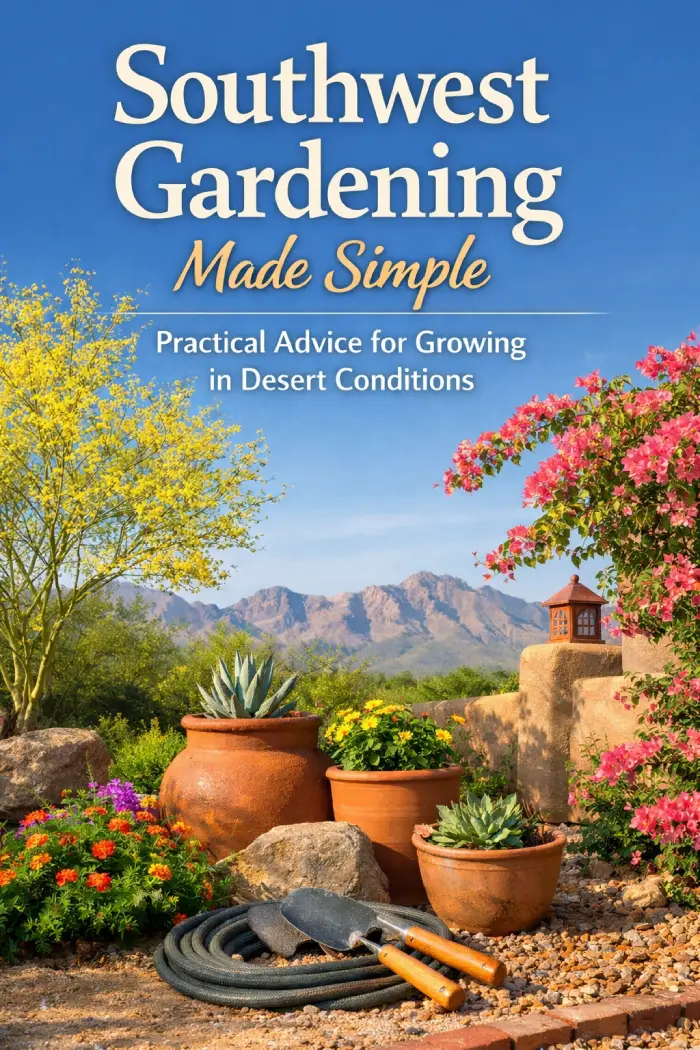
New to Southwest Gardening?
Stop wasting money on plants that will not survive our heat and drought.
My Southwest Gardening Made Simple eBook shows you which trees, shrubs, flowers, and vegetables actually thrive in New Mexico, Arizona, and West Texas.
The best plants for hot, dry climates
Common mistakes that kill Southwest plants
Easy-to-follow advice for beginners

Paul Guzman is a lifelong Southwest gardener and gardening writer with decades of experience helping homeowners grow beautiful landscapes in the desert Southwest. He writes for Guzman’s Garden Centers in Las Cruces, New Mexico, with contributing expertise from Gary Guzman, owner of Guzman’s Garden Centers. If you have any questions or enjoyed this post, feel free to share your thoughts in the comments below.