Last updated on October 10th, 2026 at 11:20 am
How to Plant a Tree Properly: A Step-by-Step Guide for Southwest Landscapes
Planting a tree may seem simple, but one small mistake can affect its health for many years. Trees planted too deeply, watered incorrectly, or placed in the wrong location often struggle to grow strong roots. Some may survive, but they never really thrive.
The good news is that planting a tree properly is not hard. You just need to follow the right steps from the beginning. This is especially important in the Desert Southwest, where heat, wind, poor soil, and dry conditions can make it harder for a new tree to get established.
Below is a simple step-by-step guide on how to plant a tree properly, whether you are adding shade, color, privacy, or long-term value to your home landscape.
Choose the Right Tree for the Right Location
Before you dig the hole, take a little time to choose the right location. This is one of the most important steps when planting a tree.
Look at the mature size of the tree, not just the size it is at the nursery. A small tree in a container can eventually grow 20, 30, or even 50 feet tall. Make sure there is enough room for the roots, branches, and overall shape of the tree as it matures.
Keep trees away from foundations, sidewalks, driveways, block walls, septic systems, and overhead power lines. Also consider how much sunlight the tree needs. Some trees love full sun, while others need a little afternoon shade, especially when they are young.
Best Time to Plant a Tree in the Southwest
In the Southwest, the best time to plant most trees is during spring or fall. These seasons give the tree time to develop new roots before the extreme heat of summer or the cold of winter arrives.
Fall is often an excellent time to plant trees because the soil is still warm, but the air temperatures are cooler. This gives roots a chance to grow with less stress on the top of the tree.
Spring is also a good time, especially if you plant early before the hot weather arrives. Avoid planting trees during the hottest part of summer unless you are prepared to water carefully and protect the tree from heat stress.
Step 1: Dig the Hole the Right Way
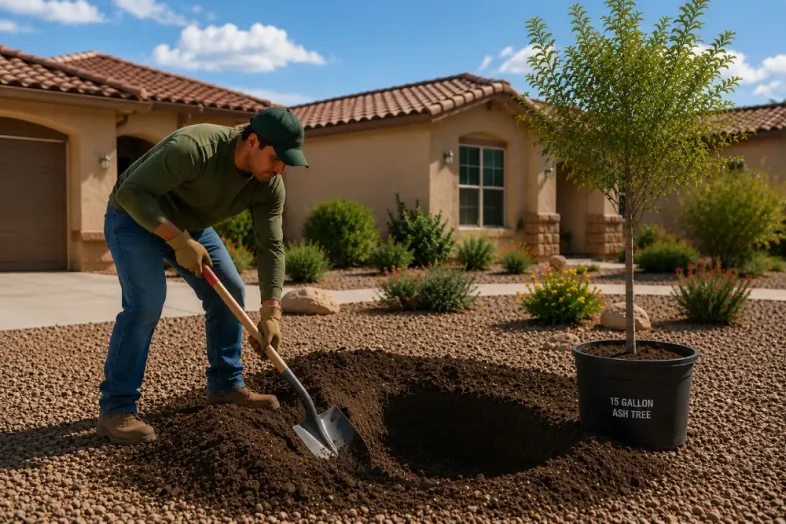
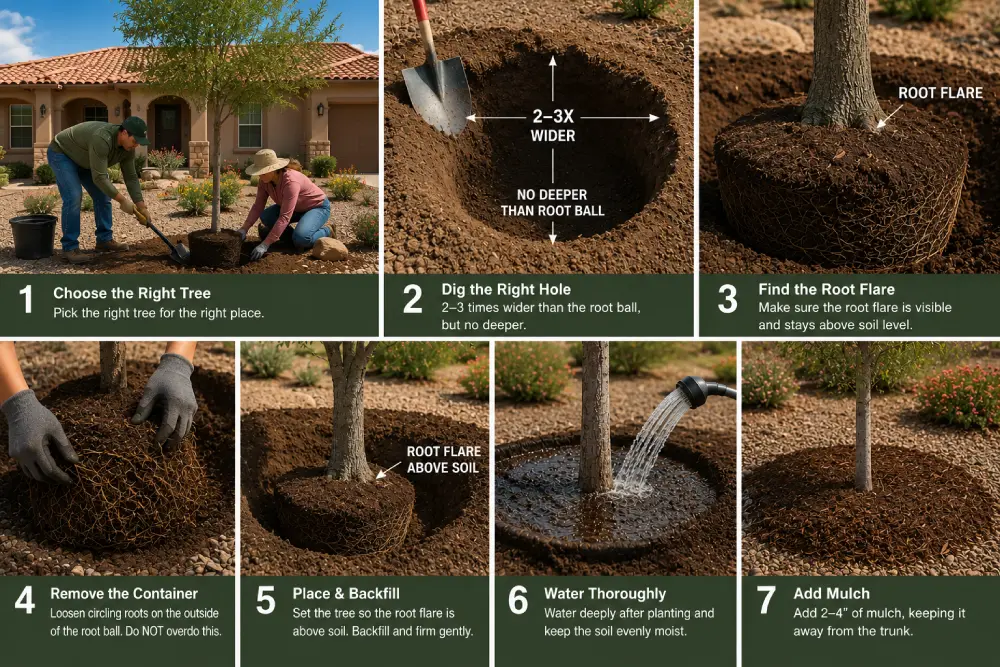
The planting hole should be about two to three times wider than the root ball, but no deeper than the root ball itself. A wide hole helps new roots spread into the surrounding soil.
Do not dig the hole too deep. This is one of the most common tree planting mistakes. If the tree is planted too low, the roots may struggle to get enough oxygen, and the trunk can begin to rot near the soil line.
The top of the root ball should sit slightly above the surrounding soil level. In heavy clay or compacted soil, planting just a little high is usually better than planting too deep.
Step 2: Find the Root Flare
The root flare is the area where the trunk begins to widen at the base of the tree. This part should be visible after planting.
Many trees from nurseries are planted too deeply in their containers. Before planting, gently remove excess soil from the top of the root ball until you can see the root flare.
Never bury the root flare with soil or mulch. A buried root flare can lead to disease, poor growth, and long-term decline.
Step 3: Remove the Tree from the Container
Carefully remove the tree from its nursery container. Try not to pull the tree by the trunk. Instead, tip the container on its side and gently slide the root ball out.
If the roots are circling around the outside of the root ball, loosen them with your hands. If they are tightly wrapped, make a few shallow cuts along the sides of the root ball with a clean knife or pruners. This helps encourage the roots to grow outward into the soil instead of continuing to circle.
Step 4: Place the Tree in the Hole
Set the tree in the center of the planting hole. Step back and look at it from more than one direction to make sure it is straight.
Check the height again. The root flare should be at or slightly above the surrounding soil level. If the tree is too low, remove it and add soil underneath the root ball until the height is correct.
Step 5: Backfill with Soil
Use mostly the same native soil that came out of the hole. This helps the tree adjust to the soil it will be growing in in the long term.
You can mix a half bag of compost and a bag ot topsoil. If your soil is extremely poor, avoid filling the hole with rich potting soil or heavy amendments. If the planting hole is too soft and rich, roots may stay inside the hole instead of spreading into the surrounding landscape.
As you backfill, gently firm the soil around the root ball to remove large air pockets. Do not stomp hard on the soil, as this can compact it too much.
Step 6: Water Thoroughly After Planting
After planting, water the tree deeply. This helps settle the soil around the roots and gives the tree a good start.
For newly planted trees in the Southwest, watering is extremely important during the first few weeks. The root ball can dry out quickly, especially during warm or windy weather.
During the first two to three weeks, check the soil often. The root ball should stay evenly moist but not soggy. After that, begin watering more deeply and less frequently to encourage roots to grow downward and outward.
Step 7: Add Mulch
Mulch is very helpful for newly planted trees. It helps keep the soil cooler, reduces evaporation, and helps control weeds around the base of the tree.
Apply mulch about two to four inches deep around the tree, but keep it several inches away from the trunk. Do not pile mulch against the trunk like a volcano. This can trap moisture, invite insects, and cause trunk problems.
A wide, flat ring of mulch is much better than a tall mound against the tree. Read Mastering Mulching.
Step 8: Should You Stake the Tree?
Not every newly planted tree needs staking. In fact, unnecessary staking can sometimes weaken a tree because the trunk needs some movement to develop strength.
Stake a tree only if it is top-heavy, leaning, planted in a windy location, or unable to stand upright on its own.
If you do stake the tree, use soft ties and allow a little movement. Do not tie the tree too tightly. Remove the stakes once the tree is stable, usually within the first year.
Step 9: Do Not Fertilize Too Soon
Many people want to fertilize a tree right after planting, but this is usually not necessary. A newly planted tree needs to focus on root growth first.
Too much fertilizer too soon can stress the tree or encourage top growth before the roots are ready to support it.
Wait until the tree is established before applying fertilizer. If you do fertilize later, use the correct product for the type of tree and follow the label directions carefully.
Common Tree Planting Mistakes to Avoid
Here are some of the most common mistakes homeowners make when planting trees:
- Planting the tree too deep
- Covering the root flare with soil or mulch
- Digging a narrow hole instead of a wide one
- Adding too much compost or topsoil
- Watering too lightly
- Watering every day for too long
- Planting too close to walls, sidewalks, or buildings
- Leaving nursery stakes on too long
- Piling mulch against the trunk
- Fertilizing before the tree is established
Southwest Tree Planting Tips
Planting trees in New Mexico, West Texas, Arizona, and other dry regions takes a little extra care. Our heat, wind, alkaline soil, and low humidity can be tough on young trees.
Choose trees that are well suited for your area. Desert-adapted and drought-tolerant trees usually perform better once established, but even drought-tolerant trees need regular watering when they are first planted.
Deep watering is better than light sprinkling. Water should soak down into the root zone instead of just wetting the surface. A drip system, slow-running hose, or tree watering basin can help water reach the roots more effectively.
During the first summer, watch the tree closely. Wilting, leaf scorch, yellowing leaves, or sudden leaf drop can be signs of stress. Sometimes the tree needs more water, but sometimes the problem is poor drainage or planting too deep.
How Often Should You Water a Newly Planted Tree?
Watering depends on the weather, soil type, tree size, and time of year. In general, newly planted trees need more frequent watering at first, then deeper watering as they begin to establish.
During hot weather, check the root ball often. If the top few inches are dry, it may be time to water again. Sandy soil dries faster, while clay soil holds moisture longer.
As the tree becomes established, slowly stretch out the time between watering. The goal is to train the roots to grow deeper into the soil.
How Long Does It Take for a Tree to Become Established?
Most newly planted trees take at least one to three years to become established. Larger trees usually take longer than smaller trees because they have a larger canopy and more transplant stress.
During this establishment period, consistent watering is very important. Once the roots have grown into the surrounding soil, the tree becomes stronger and more drought-tolerant.
Frequently Asked Questions About Planting Trees
How deep should I plant a tree?
Plant the tree so the root flare is at or slightly above the surrounding soil level. Never bury the trunk or root flare below the soil.
Should I add compost when planting a tree?
Typically, about half a bag of compost and one bag of topsoil for a small to medium-sized tree. But do not overdo it. In most cases, it is better to use mostly native soil so the roots adapt to the surrounding ground.
Should I fertilize a new tree?
It is usually best to wait. Newly planted trees need to establish roots first. Fertilizing too soon can cause stress or weak growth.
Should mulch touch the trunk?
No. Keep mulch several inches away from the trunk. Mulch should cover the soil around the tree, not the bark of the tree itself.
Can I plant a tree in summer?
You can, but it is harder on the tree. If possible, plant in spring or fall. If you must plant in summer, water carefully and watch for heat stress.
Do all trees need staking?
No. Stake only when necessary. A tree that can stand on its own usually does better without staking.
Final Thoughts
Planting a tree properly gives it the best chance to grow strong, healthy, and beautiful for many years. The most important things to remember are simple: choose the right location, do not plant too deep, expose the root flare, water deeply, and keep mulch away from the trunk.
In the Southwest, proper planting and watering are especially important. A well-planted tree can provide shade, beauty, wildlife habitat, and value to your landscape for decades.
If you are unsure which tree is best for your yard, visit your local garden center and ask for trees that are proven to grow well in your area.
More information at Treesaregood.org
New to Southwest Gardening?
Stop wasting money on plants that will not survive our heat and drought.
My Southwest Gardening Made Simple eBook shows you which trees, shrubs, flowers, and vegetables actually thrive in New Mexico, Arizona, and West Texas.
The best plants for hot, dry climates
Common mistakes that kill Southwest plants
Easy-to-follow advice for beginners

Paul Guzman is a lifelong Southwest gardener and gardening writer with decades of experience helping homeowners grow beautiful landscapes in the desert Southwest. He writes for Guzman’s Garden Centers in Las Cruces, New Mexico, with contributing expertise from Gary Guzman, owner of Guzman’s Garden Centers. If you have any questions or enjoyed this post, feel free to share your thoughts in the comments below.
My shade tree is getting kind of old and I am planting a new tree to replace it for when I finally have to cut it down. So, I appreciate your tips on how to properly plant a tree. Up till now, I have been cutting an “X” in the bottom of the root ball because I was told it would help the roots grow down. Apparently, I was told wrong.
Taking a tree out of its existing container and cutting an “X” at the bottom may damage the root system. I would gently pull it out of the container and place it the hole without disturbing the roots at all. I’ve had customers and landscapers tell me they gently loosen the outside of the roots to help get them going. But, I’ve always had success by placing them in the ground without doing anything to the soil or roots at all.
Thanks for your input James.
I read an article you wrote about using newspaper when transplanting plants in our sandy desert soil. You stated dig a hole, lay down a sheet of news paper and fill and top with 50/50 topsoil/native soil with a sprinkle of organic bonemeal. I’ve used the same newspaper method with all the shrubs and trees I’ve purchased from you and I’m happy to report my trees and shrubs are loving it !! Even my lovers of arid dry air lavenders have appreciated the newspaper bottom. I noticed with the article above you didn’t mention newspapers when planting a tree. Why then are my trees doing fantastic using your newspaper method 🙂 I hope this wasn’t an oversight.
Thanks, for your input Jessica.
No, this was not an oversight. However, the article was written by my brother Gary and published in the newspaper recently. This method does indeed work. The post I wrote (Plant a tree properly) was actually published on our website 8 years ago. In order to avoid confusion in the future, I will incorporate the newspaper and bone meal method into my published post.
Paul
Thank you so much, Paul. I’ve not shared your article with anybody nowhere near my neighborhood LOL . My husband can attest he himself did not believe your newspaper method–he found out firsthand indeed works! I wish I were able to share photos of my trees and shrubs and veggies that have your newspaper method that I laid down vs the ones did not since Im a passionate gardener I couldn’t bear NOT to give a plant one sheet of newspaper (using absolutely no gloss pages). For your customers, here are my steps for your method: dig hole, water thoroughly, at sheet of paper, fill 1/4-1/2 way with your top quality tree and shrub soil (if planting such), 1/4 of native soil, 1/4 C organic bone meal, rake or mix thoroughly, lightly water mixture, set tree or shrub, fill using your 50/50 native soil/topsoild or tree or shrub. water thoroughly and viola ! Healthly plants with a great headstart in the ground all thanks to you!! I’ve had a black thumb all my life until recently but WOW your valuable tips awakened ourpassion to keep planting. Thank you! Thank you Paul! God Bless!
Thank You Jessica. This is an excellent comment it will benefit those who are looking for successful planting tips. Thanks for your comment and God Bless you.
Paul
This is such a great how to, step by step protocol. Thanks alot!
How do you avoid Caliches deposits? Or can you tell before you plant if there is a Caliches barrier. I have lost two trees after their roots struck shale!
Clayish soil (AKA caliche) is hard dirt and will retain water, this will make your plants and lawn susceptible to root rot and fungus. Try aerating the hard soil with an aerating tool. You could rent one at your local nursery or rent center. The thing to do is aerate then incorporate some gypsum into the soil. This will help loosen the soil. The one caveat to all this is that It will take several applications over the course of several years before you get good results!
Shouldn’t new trees be staked to keep the roots from moving around before they take hold?
Hello, Patsy. Yes, medium to smaller sized trees should be staked down especially during the Southwest windy seasons. I will soon write a post on how to properly stake a newly planted tree. Thanks for reminding me.
I have several very small trees to plant this fall–any tips will be helpful and appreciated since I have NEVER planted trees. These are tender and not very tall from root stock
Please send some tips
Thanks for this Paul, I might need this because I’m planning to plant one in our backyard. Hope I can email you for related questions.
Absolutely, please keep in touch.
Thanks for this guide. I love how short and to the point it is!
Thanks, for your comment Burt we value our visitor’s comments.
Thanks, Paul on your tree planting tips. I didn’t know you could still plant your trees in the mid-winter.
Hello, Mike. Yes, you can plant trees in and around the southwest area. However, up north where the ground freezes really hard it’s best to wait until the end of winter. Thanks for your comment.
There is more to planting a tree than just throwing it in the ground. Thanks for these tree planting tips.
Yes, purchasing a tree does cost money and the last thing you want is for it to die because of improper planting. There are different techniques for other parts of the USA. In the Southwest, the soil is typically sandy and lacking nutrients.
If you are going to take the time and money to plant a tree, you might as well do it right. Thanks for all the info.
A great guide on tree planting. I appreciate your effort just to teach readers the basic steps of planting trees. Tree Service Charlottesville.
Thanks, for the positive comment Hunter.
So nice guide! We need to enlighten the world to plant more trees. This post helps a lot for us. Harrisonburg Tree Service Company.
This is a pretty complete list on how to plant a tree the proper way, we need more lists like this one more than ever! It’s vital that we start reforestaring every free space we can help save the earth! and after you’re all hot and tired from all the work planting the tress I’m sure that you’ll want to refresh yourself in a room with AC, so call my top 1 ac services in gainesville to ensure that your AC is working at a 100%!
Very much appreciated. Thank you for this excellent article. Keep posting!
Thanks for the compliment.
The depth point is one most folks get wrong — burying the root flare is a slow death sentence and so easy to avoid. Wish someone had told me this before I lost two young maples to good intentions.