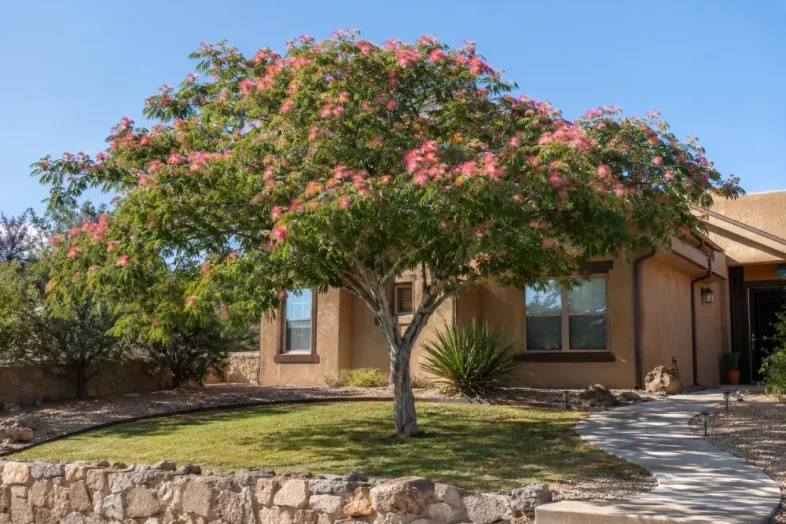
The Mimosa tree (Albizia julibrissin), also known as the Persian silk tree, is a fast-growing deciduous tree with a broad, spreading canopy. Its delicate, fern-like foliage and fluffy summer flowers give it a soft, tropical appearance. Despite that tropical look, an established Mimosa tree can tolerate the intense heat, alkaline soil, and dry conditions found throughout much of the desert Southwest.
Most Mimosa trees grow between 20 and 35 feet tall with a similar spread. Their wide canopy provides filtered shade rather than the dense shade produced by mulberry, ash, or elm trees. This makes the Mimosa a good choice for homeowners who want summer shade while allowing some sunlight to reach the plants growing underneath.
Mimosa trees lose their leaves in late fall or early winter. New foliage normally appears in mid-to-late spring after temperatures become consistently warm.
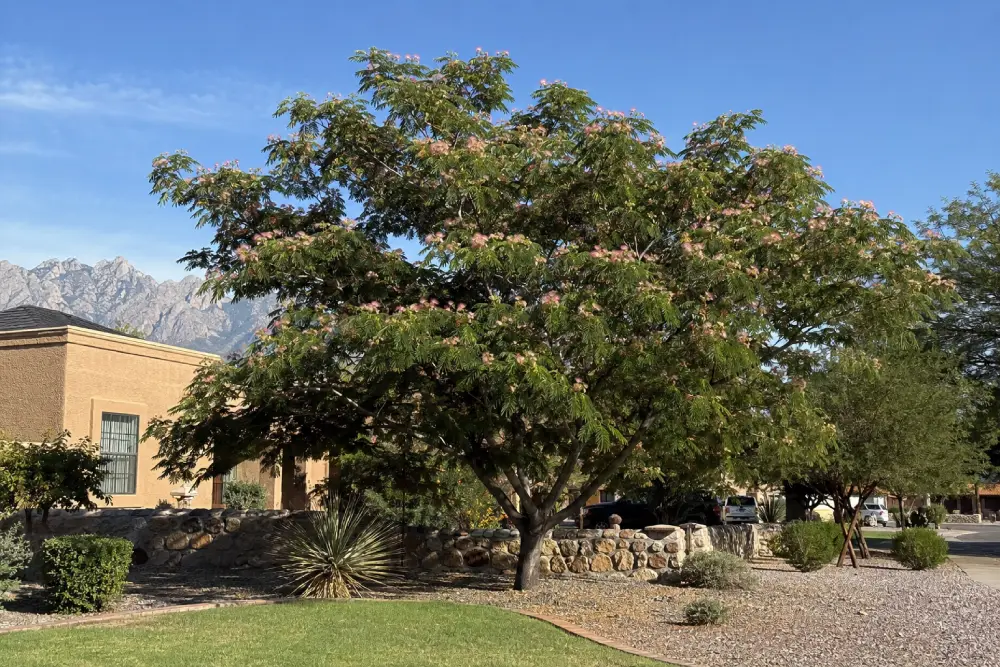
Common Mimosa Tree
The common Mimosa has medium-green, feathery leaves made up of numerous small leaflets. These leaflets frequently fold together at night or during periods of rain.
Pink, powder-puff flowers appear during summer, usually from late May through July. The fragrant flowers attract bees, butterflies, hummingbirds, and other pollinators. After flowering, the tree produces long, flat seedpods that turn brown as they mature.
The common variety is a fast grower and can reach approximately 20 to 35 feet tall and equally wide. Its branches naturally spread outward, eventually forming a wide, umbrella-shaped canopy.
One disadvantage is that the branches can be somewhat brittle. Young trees should be pruned carefully to develop several well-spaced, sturdy limbs. Avoid allowing multiple branches to grow from the same narrow point on the trunk.
Mimosa trees are considered Shade Trees.
Chocolate Mimosa Tree
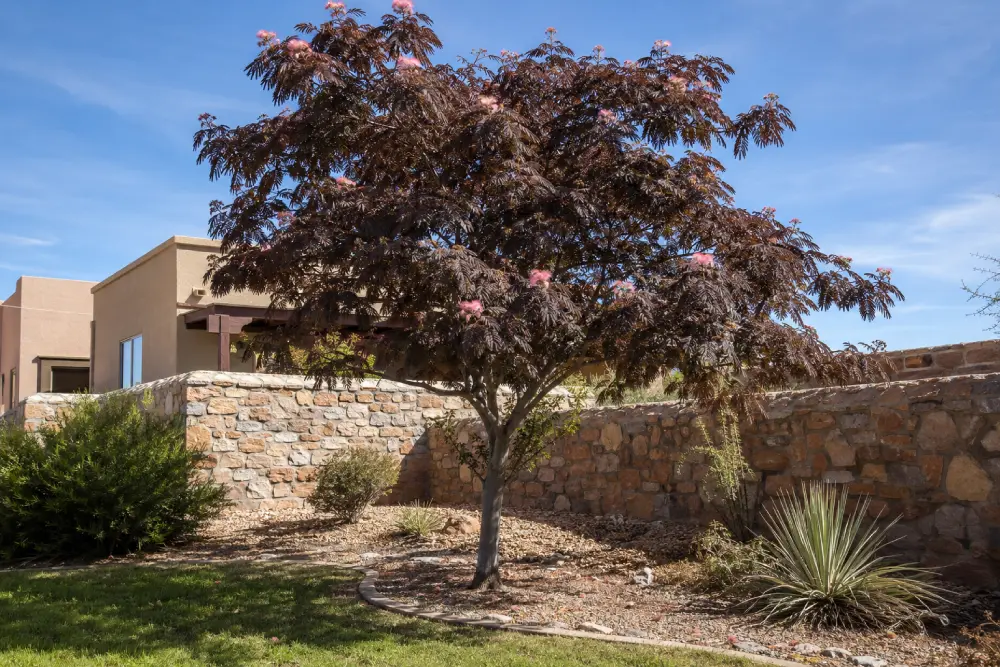
The Chocolate Mimosa, commonly sold as Albizia julibrissin ‘Summer Chocolate’, is grown primarily for its unusually dark foliage. The leaves emerge green or bronze in spring and gradually change to deep burgundy, reddish-purple, or chocolate brown as temperatures become warmer.
Its pink and white flowers stand out beautifully against the dark foliage. The combination of burgundy leaves and fluffy pink flowers makes it one of the most distinctive small ornamental shade trees for a Southwest landscape.
The Chocolate Mimosa usually grows approximately 20 feet tall and 15 to 20 feet wide, although its mature size depends on soil, irrigation, and winter temperatures. It may grow more slowly than the common green Mimosa, especially during its first several years.
Plant the Chocolate Mimosa in full sun to develop the best leaf color. Too much shade can cause its leaves to remain green or bronze instead of developing their characteristic dark chocolate color.
‘Summer Chocolate’ is also reported to produce fewer viable seeds than the common Mimosa. Some horticultural references describe it as sterile or nearly sterile, making it a better choice where unwanted seedlings are a concern.
Red Mimosa Tree
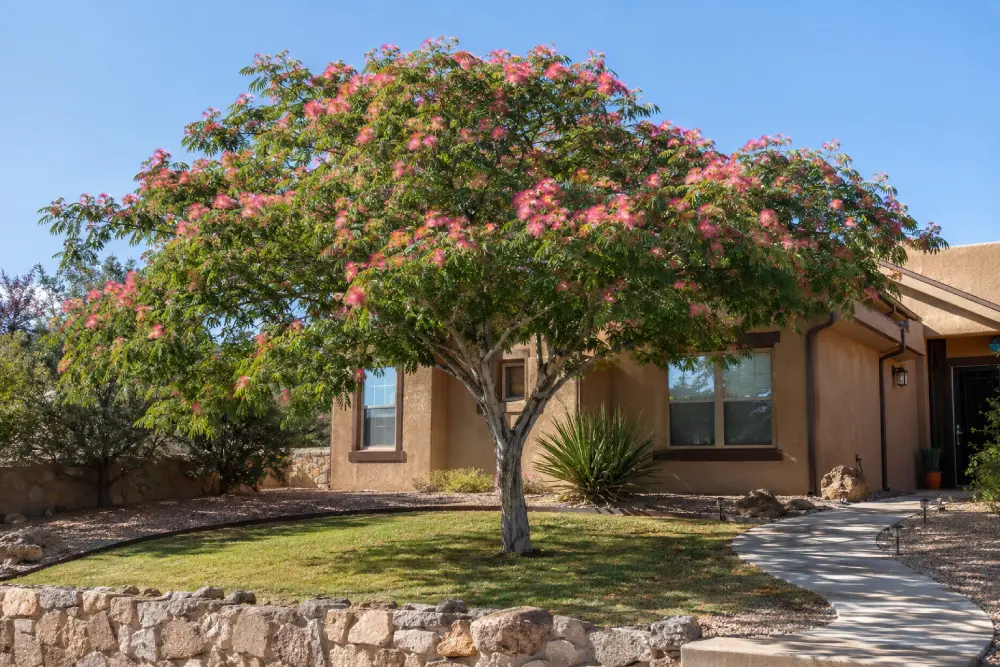
The tree commonly sold as a Red Mimosa is usually Albizia julibrissin ‘Rosea’, sometimes listed as Albizia julibrissin forma rosea. It may also be sold under the cultivar names ‘E.H. Wilson’ or ‘Ernest Wilson’.
The flowers are not normally a true bright red. Instead, they are deeper rose-pink, reddish-pink, or dark pink compared to the flowers of a standard Mimosa. The darker flower color is why many nurseries use the common name “Red Mimosa.”
The Red Mimosa generally stays smaller and more compact than the standard green variety. It commonly grows approximately 15 to 25 feet tall with a spreading canopy. It is also more cold-tolerant than many other Mimosa selections, making it a good choice for colder areas of New Mexico and the higher elevations of the Southwest.
Always check the botanical name on the nursery label. The common name “Red Mimosa” is sometimes used loosely for different dark-pink-flowering selections.
New Mexico State University lists the Rosea Mimosa as a moderate-water shade tree suitable for central and southern New Mexico.
How Much Water Does a Mimosa Tree Need?
Mimosa trees are drought-tolerant after they have developed an established root system, but they are not completely drought-free. They will grow faster, flower more heavily, and maintain better-looking foliage when given occasional deep watering.
Newly planted trees require more frequent irrigation:
- During the first several weeks, water deeply two or three times per week, depending on the temperature and soil drainage.
- During the remainder of the first growing season, gradually reduce watering to approximately once or twice per week.
- During the second and third years, water deeply every 7 to 14 days during hot, dry weather.
- Once established for at least three years, a Mimosa may need deep watering approximately two times per month during peak summer heat.
These are general guidelines. Sandy soil dries faster and may require more frequent watering. Heavy clay soil retains moisture longer and should be watered less often.
Each watering should soak the ground deeply rather than wetting only the soil immediately around the trunk. As the tree grows, move the drip emitters outward toward the edge of the canopy. Most of the active feeder roots will eventually be located away from the trunk.
A Mimosa growing in Bermuda grass may receive some moisture from the lawn, but shallow lawn watering is not a substitute for deep tree irrigation.
Soil Requirements
Mimosa trees are adaptable and can grow in many Southwestern soils, including sandy, rocky, clay, alkaline, and slightly salty soil. New Mexico State University describes the silk tree as tolerant of extended drought, high-pH soil, and soil salinity.
However, the best growth occurs in well-drained soil that contains some organic matter. Avoid planting a Mimosa in a low area where irrigation or rainwater remains around the roots.
When planting, dig a hole approximately two to three times wider than the root ball but no deeper than the root ball itself. The top of the root ball should remain level with, or slightly above, the surrounding soil. Planting too deeply can hold moisture against the trunk and reduce the amount of oxygen available to the roots.
A two-to-three-inch layer of mulch will help conserve moisture and moderate soil temperatures. Keep the mulch several inches away from the trunk.
Sunlight and Heat
Plant Mimosa trees in full sun. They need at least six hours of direct sunlight per day to develop a strong canopy and produce abundant flowers.
The Chocolate Mimosa especially needs strong sunlight to bring out its burgundy and chocolate-colored foliage. A tree growing in too much shade may become thin, lean toward the light, and produce fewer flowers.
Mimosas handle Southwestern summer heat remarkably well. They may temporarily fold their leaflets during extreme heat or drought, but this does not necessarily mean the tree is dying. Deep watering will usually help the foliage recover.
Are Mimosa Trees Invasive in the Southwest?
Mimosa trees are considered invasive in parts of the southeastern United States, where abundant rainfall, humid summers, moist roadsides, and flowing waterways allow their seeds to germinate and spread easily. The species has escaped cultivation and formed colonies in some wetter parts of the country.
Conditions are different across much of the arid Southwest. Low rainfall, dry desert soil, intense heat, and the lack of consistently moist ground make it more difficult for large numbers of Mimosa seeds to germinate and survive without irrigation. Seedlings that appear in dry, unirrigated areas usually die before becoming established.
For this reason, Mimosa trees generally do not spread as aggressively in southern New Mexico and similar dry areas as they do in humid eastern states. New Mexico State University includes Mimosa among the trees suitable for New Mexico landscapes and classifies it as a moderate-water-use tree.
However, it would be inaccurate to say that a Mimosa can never spread in the Southwest. Seedlings may appear:
- Around regularly irrigated lawns and flowerbeds
- Along leaking irrigation lines
- Near ponds, drainage channels, or seasonal waterways
- In areas receiving regular monsoon runoff
- Beneath mature trees where seedpods accumulate
Remove unwanted seedlings while they are small. Gardeners concerned about reseeding should consider the Chocolate Mimosa because it produces considerably fewer viable seeds than the standard species.
Invasiveness can also vary by state and local environment. Parts of Texas and California have wetter habitats where Mimosa trees can naturalize. Always check local invasive-plant recommendations before planting one near a natural waterway or undisturbed habitat.
Mimosa Tree Problems
The Mimosa is attractive, but it is not a perfect tree. Mature seedpods can create litter, and the tree may drop small leaves, flowers, and twigs throughout the season.
The branches can break during strong winds, especially when a tree has weak branch connections. Structural pruning during the early years will help produce a stronger canopy.
Mimosa webworms may cover sections of the foliage with webbing and cause leaves to turn brown. Severe infestations can make the tree look unattractive, although a healthy tree will often recover. Mimosa vascular wilt is a more serious fungal disease that can cause branch dieback and eventually kill the tree. There is no reliable cure once a tree becomes heavily infected.
Is a Mimosa Tree Right for Your Landscape?
A Mimosa tree is a good choice when you want a relatively small, fast-growing tree with filtered shade and colorful summer flowers. The common green Mimosa provides the fastest growth, the Chocolate Mimosa offers dramatic dark foliage, and the Red or ‘Rosea’ Mimosa provides deeper pink flowers along with better cold tolerance.
Give the tree plenty of space, full sun, well-drained soil, and deep but infrequent watering once it becomes established. Although the standard Mimosa can reseed, the hot and dry conditions found across much of the desert Southwest generally prevent it from becoming as invasive as it can be in humid regions. Regular cleanup of seedpods and removal of occasional seedlings will help keep it under control.
New to Southwest Gardening?
Stop wasting money on plants that will not survive our heat and drought.
My Southwest Gardening Made Simple eBook shows you which trees, shrubs, flowers, and vegetables actually thrive in New Mexico, Arizona, and West Texas.
The best plants for hot, dry climates
Common mistakes that kill Southwest plants
Easy-to-follow advice for beginners

Paul Guzman is a lifelong Southwest gardener and gardening writer with decades of experience helping homeowners grow beautiful landscapes in the desert Southwest. He writes for Guzman’s Garden Centers in Las Cruces, New Mexico, with contributing expertise from Gary Guzman, owner of Guzman’s Garden Centers. If you have any questions or enjoyed this post, feel free to share your thoughts in the comments below.