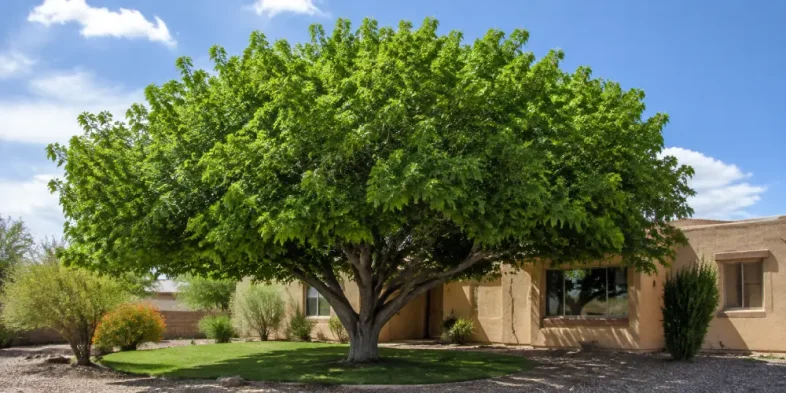
The Fruitless Mulberry Tree (Morus alba) is a fast-growing deciduous shade tree commonly found throughout Las Cruces and the Desert Southwest. Older neighborhoods often have large mulberry trees that provide wonderful shade during our hottest summer months.
A mature Fruitless Mulberry develops a wide, spreading canopy with large green leaves. When properly placed and maintained, it can shade a patio, lawn, or the west side of a home. However, this tree also has several disadvantages—including aggressive surface roots, heavy spring pollen, and considerable leaf cleanup.
Before planting one, make sure you understand both the advantages and disadvantages.
What Is a Fruitless Mulberry Tree?
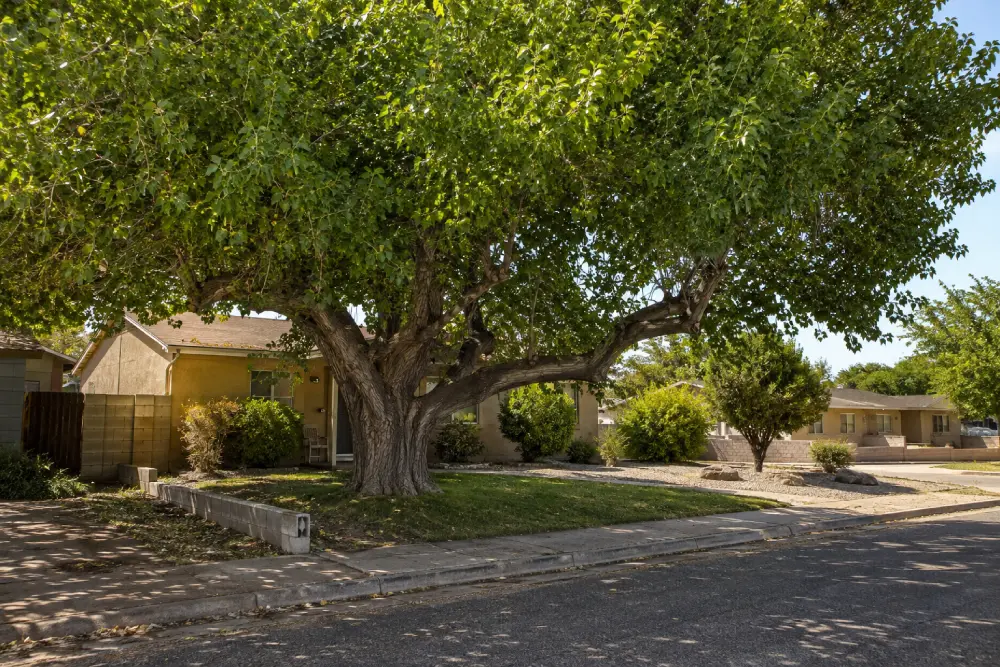
The Fruitless Mulberry is usually a male selection of the White Mulberry, botanically known as Morus alba. Unlike female mulberry trees, it does not produce the dark berries that stain sidewalks, patios, vehicles, and outdoor furniture.
However, “fruitless” does not mean pollen-free. In fact, male mulberry trees can produce large amounts of airborne pollen during spring.
Fruitless Mulberry trees generally grow between 30 and 50 feet tall, with a canopy that may become equally wide. Their exact size depends on the variety, available water, soil conditions, pruning, and growing climate.
Why Fruitless Mulberry Trees Grow Well in Las Cruces
Fruitless Mulberries tolerate heat, alkaline soil, wind, and many of the difficult growing conditions found in southern New Mexico. They are adaptable trees that can grow in sandy, rocky, or clay-type soil as long as the planting area drains reasonably well.
They grow best in:
- Full sun
- Well-draining soil
- A large, open planting area
- Locations away from sidewalks, foundations, walls, and underground plumbing
- Areas where the falling leaves will not create a major cleanup problem
Although established trees tolerate drought, they are not truly low-water desert trees. A large mulberry will grow faster and maintain a fuller canopy when it receives deep, regular irrigation.
Advantages of the Fruitless Mulberry Tree
1. It Grows Quickly
One of the biggest advantages is its fast growth. Under good growing conditions, a young tree can add several feet of growth during a growing season.
This makes it appealing to homeowners who need shade and do not want to wait many years for a tree to mature.
2. It Produces Excellent Summer Shade
The broad canopy and large leaves create dense shade. A properly located tree can help cool a patio, lawn, or sunny side of a house.
In Las Cruces, where afternoon temperatures can remain high for months, this shade can make an outdoor area much more comfortable.
3. It Does Not Produce Messy Berries
Female mulberry trees produce berries that can fall onto pavement and stain almost everything underneath them. Birds also eat the fruit and may spread the mess to other areas.
A genuine Fruitless Mulberry avoids this particular problem.
4. It Tolerates Southwestern Conditions
Once established, Fruitless Mulberries tolerate heat, dry air, and alkaline soil better than many traditional shade trees. They are also fairly adaptable to different soil types.
5. It Provides Seasonal Shade
Because it is deciduous, the tree loses its leaves during winter. Its summer canopy blocks intense sunlight, while its bare winter branches allow more warming sunlight to reach the home and landscape.
Disadvantages of the Fruitless Mulberry Tree
1. It Produces Large Amounts of Pollen
This is probably the tree’s biggest disadvantage. Fruitless Mulberries are generally male trees, and male trees produce pollen instead of fruit.
NMSU identifies fruitless white mulberries as serious pollen-allergy offenders. People with seasonal allergies or asthma should think carefully before planting one, especially near bedroom windows, air-conditioning intakes, patios, or frequently used outdoor spaces.
Some municipalities, including Albuquerque, prohibit new mulberry plantings because of their pollen. Check local regulations before planting one outside the Las Cruces area.
2. It Develops Large Surface Roots
Fruitless Mulberries develop vigorous, wide-spreading roots. As the tree matures, some roots may appear at or above the soil surface.
These roots can:
- Lift or crack nearby sidewalks
- Interfere with mowing
- Compete with lawn grass and other plants
- Grow toward irrigated areas
- Create problems near walls, patios, and underground pipes
Do not plant this tree in a narrow strip between a sidewalk and street. Give it plenty of open space and keep it well away from structures and paved areas.
3. It Requires Plenty of Room
A mature tree can become wider than many homeowners expect. A small front yard may eventually be almost completely covered by its canopy.
Before planting, look upward and outward. Check for power lines, rooflines, neighboring properties, walls, and other mature trees.
4. It Drops a Large Amount of Leaves
Even though the tree does not produce fruit, it is not maintenance-free. Large quantities of leaves fall during late autumn and early winter.
A mature tree can cover lawns, rock landscapes, roofs, gutters, patios, and walkways with leaves.
5. Its Fast Growth Can Produce Weak Branches
Fast growth is convenient, but it can also lead to long, heavy limbs and poor branch structure. Young trees should be trained early to develop well-spaced scaffold branches.
Avoid repeatedly cutting the entire canopy back to large stubs. This practice, commonly called topping, encourages weak shoots and can shorten the useful life of the tree.
Where Should You Plant a Fruitless Mulberry?
Choose a large, open area where the tree can develop naturally. Keep it well away from sidewalks, driveways, block walls, septic systems, sewer lines, swimming pools, and the home’s foundation.
As a practical guideline, allow at least 20 to 25 feet of space between the trunk and major structures whenever the property permits. More room is even better for a full-sized tree.
Do not plant underneath utility lines. A tree planted in the wrong place may eventually require frequent and unattractive pruning to keep it away from wires.
How to Water a Fruitless Mulberry Tree
Newly planted mulberries need consistent watering while their roots become established. Water deeply enough to moisten the entire root ball and the surrounding soil.
During the first two growing seasons:
- Check the soil regularly
- Water deeply instead of lightly sprinkling the surface
- Allow the upper soil to begin drying between waterings
- Expand the watering area as the tree grows
An established tree should be watered deeply across a broad area underneath and slightly beyond its canopy. Do not concentrate all the water directly against the trunk.
The exact schedule depends on temperature, soil type, tree size, wind, and rainfall. Sandy soil dries quickly, while compacted clay soil holds moisture longer. Always check the soil before watering again.
Fertilizing Fruitless Mulberry Trees
Mulberries usually do not need heavy fertilization. Too much nitrogen can produce excessive, weak growth that requires more pruning and may be more vulnerable to storm damage.
If the tree has healthy green leaves and produces adequate annual growth, fertilizer may not be necessary.
Yellow leaves with darker green veins can indicate iron chlorosis, which is common in our alkaline Southwestern soil. Before applying fertilizer or iron, make sure poor drainage, overwatering, root damage, and improper watering are not causing the problem.
How and When to Prune
The best time for major corrective pruning is generally during the dormant season, after the leaves fall and before spring growth begins.
Young trees benefit from careful structural pruning. Remove:
- Dead or damaged branches
- Crossing or rubbing limbs
- Weakly attached branches
- Unwanted shoots growing from the trunk or roots
- Branches interfering with roofs, walkways, or vehicles
Avoid removing too much of the canopy at one time. Mature trees with large or dangerous limbs should be inspected and pruned by a qualified tree professional.
Common Fruitless Mulberry Problems
Fruitless Mulberries are tough trees, but they can experience:
- Aphids and scale insects
- Spider mites during hot, dry weather
- Leaf scorch
- Iron chlorosis
- Cankers
- Root and trunk damage
- Branch dieback
- Weak shoots caused by topping
- Premature leaf drop from drought stress
Keeping the tree healthy begins with correct planting, deep watering, adequate growing room, and sensible pruning.
Is the Fruitless Mulberry a Good Tree for Your Yard?
A Fruitless Mulberry may be worth keeping if you already have a healthy, well-positioned tree. Its dense summer shade can be extremely valuable in Las Cruces.
Planting a new one requires more consideration. The tree grows rapidly and provides excellent shade, but its pollen, surface roots, large size, and leaf cleanup can become serious disadvantages.
If someone in your home has severe pollen allergies, or if your available planting space is small, another shade tree may be a better choice.
The Chinese Pistache Tree is a good alternative.
Fruitless Mulberry Tree FAQ
Does a Fruitless Mulberry ever produce fruit?
A true male Fruitless Mulberry normally does not produce fruit. However, mislabeled trees, grafted trees, or unusual flowering changes may occasionally result in limited fruit production.
How fast does a Fruitless Mulberry grow?
It is considered a fast-growing shade tree. Young trees receiving adequate water can add several feet of growth during favorable growing seasons.
How big does a Fruitless Mulberry get?
Most grow approximately 30 to 50 feet tall and can develop an equally broad canopy. Older trees with adequate water may become larger.
Are Fruitless Mulberry roots invasive?
The roots are vigorous and frequently grow close to the soil surface. They can lift pavement and compete with nearby plants, particularly when the tree is planted in a confined area.
Is a Fruitless Mulberry drought tolerant?
An established tree can survive dry conditions, but it grows and looks better with occasional deep irrigation. It generally uses more water than native desert trees.
Do Fruitless Mulberry trees cause allergies?
They can. Fruitless Mulberries are normally male trees that release large amounts of airborne pollen in spring. They are not a good choice near homes occupied by people with serious pollen allergies or asthma.
Can you plant a Fruitless Mulberry close to a house?
It is better to give it considerable room. Its mature canopy and spreading roots can create problems when planted too close to foundations, roofs, walls, walkways, or utility lines.
Should a Fruitless Mulberry be topped every year?
No. Repeated topping produces clusters of weakly attached shoots and can damage the tree. Selective structural pruning is a healthier method.
More information on the fruitless mulberry tree below.
NMSU identifies fruitless white mulberries
Final Thoughts
The Fruitless Mulberry is one of the fastest ways to create substantial shade in a Southwestern landscape. Older trees provide welcome relief from the Las Cruces summer sun and can shade a surprisingly large area.
However, this is not the right tree for every landscape. Plant it only where there is plenty of room for its canopy and roots, and remember that the fruitless varieties can be heavy pollen producers.
As with any shade tree, selecting the right location before planting will prevent many expensive problems later.
Are Fruitless Mulberry trees banned?
Fruitless Mulberry trees are not banned everywhere, but some cities prohibit new plantings because male trees produce large amounts of allergenic pollen. White Mulberry is also regulated as an invasive plant in certain states. Always check local regulations before purchasing or planting one. Albuquerque prohibits new mulberry plantings, but this restriction does not apply statewide throughout New Mexico.

New to Southwest Gardening?
Stop wasting money on plants that will not survive our heat and drought.
My Southwest Gardening Made Simple eBook shows you which trees, shrubs, flowers, and vegetables actually thrive in New Mexico, Arizona, and West Texas.
The best plants for hot, dry climates
Common mistakes that kill Southwest plants
Easy-to-follow advice for beginners

Paul Guzman is a lifelong Southwest gardener and gardening writer with decades of experience helping homeowners grow beautiful landscapes in the desert Southwest. He writes for Guzman’s Garden Centers in Las Cruces, New Mexico, with contributing expertise from Gary Guzman, owner of Guzman’s Garden Centers. If you have any questions or enjoyed this post, feel free to share your thoughts in the comments below.