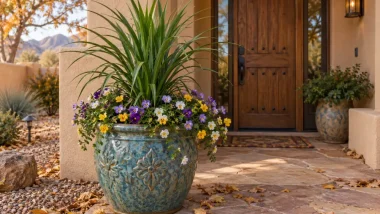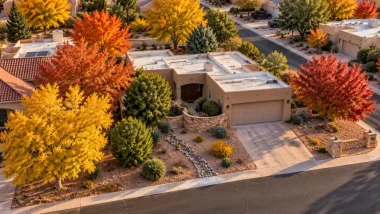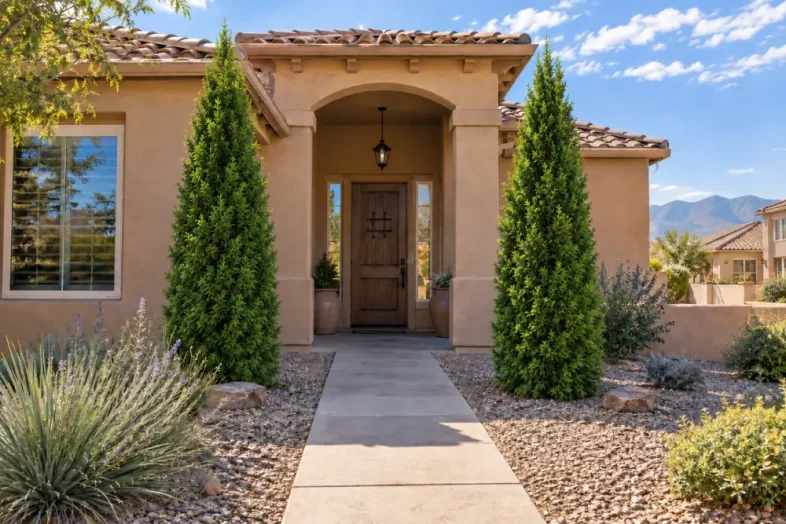
Arborvitae trees for the Southwest are popular evergreens used for privacy, wind protection, border walls, and year-round color. Their dense foliage and naturally upright shape make them useful along property lines, backyard walls, driveways, patios, and home entrances.
However, growing arborvitae in the Desert Southwest is different from growing them in cooler, wetter parts of the country. Our intense sunlight, dry winds, alkaline soil, and low humidity can be hard on these evergreens. Arborvitae are not true desert plants, but the right type can grow successfully when planted in a good location and watered correctly.
One of the biggest mistakes people make is assuming arborvitae become completely drought-tolerant once established. They can handle short dry periods, but they still need regular deep watering in New Mexico, Arizona, West Texas, Southern Nevada, and other dry Southwestern areas.
If you are considering arborvitae for your landscape, here are four good types to consider, including a smaller golden variety that does especially well in our area.
What Is an Arborvitae Tree?
The name arborvitae means “tree of life.” Most arborvitae belong to the genus Thuja, which is part of the cypress family.
Their evergreen foliage consists of soft, flattened sprays instead of long, sharp needles. Most varieties naturally develop a pyramidal, columnar, rounded, or cone-shaped form. This means they usually require less pruning than many other evergreen screening plants.
Arborvitae are commonly used as:
- Privacy screens
- Living fences
- Windbreaks
- Property-line borders
- Foundation plants
- Patio screens
- Background plants
- Evergreen accents
- Container plants
They are especially useful where a homeowner wants to soften the appearance of a long concrete-block, stucco, or rock wall. A row of arborvitae adds height, texture, and greenery throughout the year.
The smaller varieties can also be planted near entrances, patios, walkways, and other areas where a large tree would eventually become too big.
Do Arborvitae Trees Grow in the Southwest?
Yes, several arborvitae varieties can grow in the Southwest, but choosing the right location is important.
In their natural environment, many arborvitae grow where there is more moisture, higher humidity, and cooler summer weather. Our Southwestern climate exposes them to strong sunlight, reflected heat, dry air, and hot winds.
Arborvitae usually perform best when they receive plenty of morning sunlight and some protection from the hottest late-afternoon sun. They can grow in full sun, but a tree planted directly beside a hot west-facing wall may struggle during July and August.
Avoid planting arborvitae where they are completely surrounded by concrete, artificial turf, or large areas of decorative gravel. These materials absorb heat during the day and release it around the plant later. Temperatures near a west-facing border wall can be considerably hotter than the reported outdoor temperature.
Arborvitae also need soil that drains well. Their roots need regular moisture, but they should never remain in soggy soil for long periods.
Four Arborvitae Types for Southwestern Landscapes
There are many arborvitae varieties available, but they do not all perform equally well in our climate. The following four choices offer different sizes, colors, and uses for Southwestern landscapes.
1. Green Giant Arborvitae
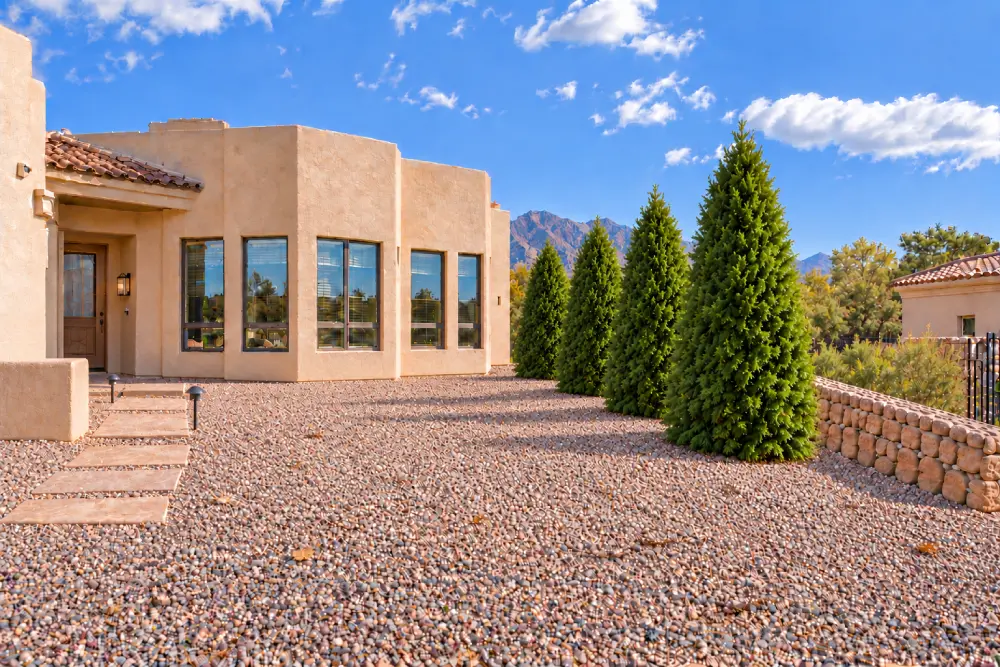
Green Giant arborvitae is a large, fast-growing evergreen that works well when you need a tall privacy screen, windbreak, or living border.
It has dense, deep-green foliage and a naturally pyramidal shape. Under ideal growing conditions, it can grow several feet per year. Growth will normally be slower in the Southwest because of our limited rainfall, alkaline soil, and extreme summer temperatures.
A mature Green Giant can eventually reach 40 to 60 feet tall and 12 to 18 feet wide. This is not a small plant, so give it plenty of room to develop.
Green Giant arborvitae works best for:
- Large properties
- Tall privacy screens
- Blocking two-story buildings
- Wind protection
- Screening a busy street
- Planting along a long border wall
Space Green Giants approximately 6 to 8 feet apart when creating a privacy screen. Do not plant them two or three feet apart simply because the young trees look small at the garden center. Closely spaced trees eventually compete for water, sunlight, and growing space.
They should also be planted far enough away from a wall to accommodate their mature width. In most landscapes, allow at least 5 to 6 feet between the trunk and the wall. More space may be needed if you do not want to prune the wall side regularly.
Green Giant is more tolerant of heat and occasional dry conditions than some traditional arborvitae varieties, but it is still not a xeriscape tree. It needs consistent irrigation in our Southwest climate.
The NC State Extension Plant Toolbox describes Green Giant as a fast-growing evergreen that tolerates several soil types and periodic drought. It also warns homeowners to provide enough room for its large mature size.
2. Emerald Green Arborvitae
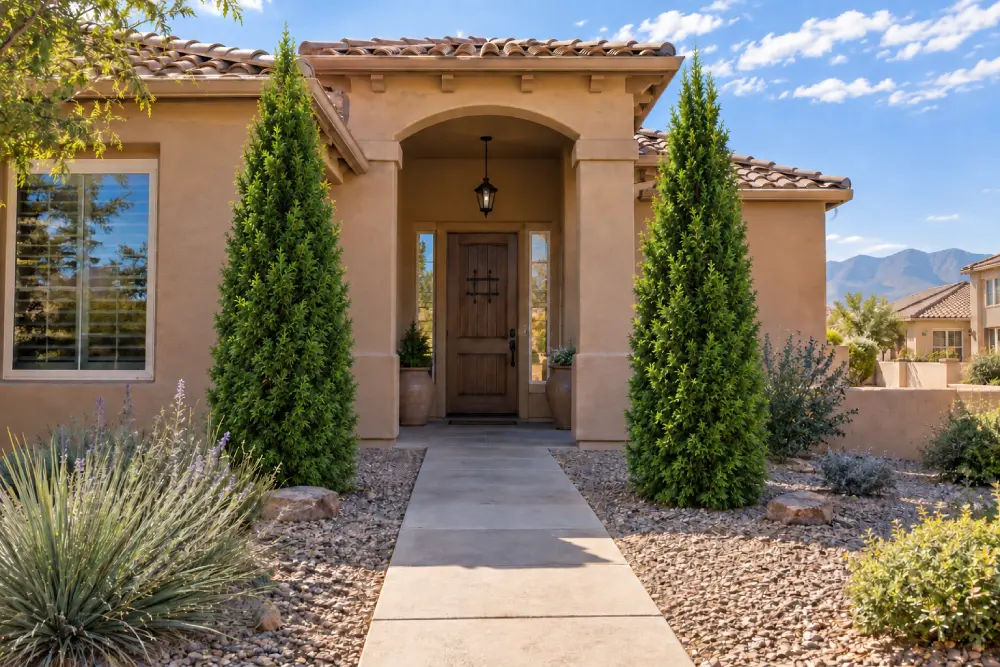
Emerald Green arborvitae is a narrower and more manageable choice for residential landscapes. It develops a compact, upright form with attractive bright-green foliage.
It commonly grows about 10 to 15 feet tall and 3 to 4 feet wide. In a Southwest landscape, its final size and growth rate depend on soil preparation, irrigation, and protection from extreme heat.
Emerald Green arborvitae works well for:
- Smaller residential yards
- Narrow planting areas
- Patio privacy
- Formal entrances
- Shorter privacy screens
- Planting near border walls
Space Emerald Green arborvitae approximately 3 to 4 feet apart when creating a continuous screen. If you want to see the individual shape of each tree, space them farther apart.
This variety is often chosen for planting along border walls because it does not become nearly as wide as Green Giant. However, avoid squeezing it into an extremely narrow area. Leave approximately 3 feet between the trunk and the wall whenever space allows.
Emerald Green can suffer from foliage burn when planted against a west-facing wall or in an area receiving reflected afternoon heat. A location with morning sun and filtered afternoon shade is better in hot areas such as Las Cruces, El Paso, Tucson, and Phoenix.
The soil should be kept evenly moist while the plant becomes established. If Emerald Green arborvitae becomes severely dry, its foliage may turn brown. Once an arborvitae branch becomes completely brown and brittle, it rarely turns green again.
3. Oriental Arborvitae
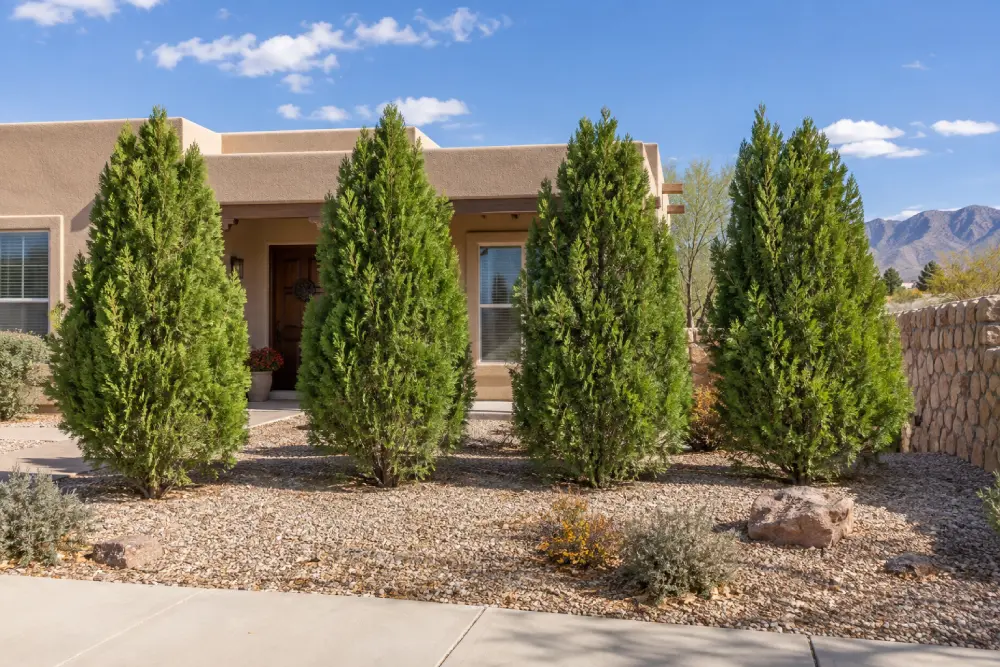
Oriental arborvitae, botanically known as Platycladus orientalis, was formerly classified in the Thuja genus. It is still commonly sold and recognized as an arborvitae.
This type is often a better match for warmer, drier climates than many northern arborvitae varieties. It handles heat and alkaline soil better once established, although it still needs supplemental water in the Desert Southwest.
Depending on the variety, an Oriental arborvitae may grow from 10 to 20 feet tall and approximately 6 to 12 feet wide. Some forms stay smaller, while others develop into tall shrubs or small trees.
Oriental arborvitae works well for:
- Informal privacy screens
- Property-line plantings
- Evergreen background color
- Southwestern courtyards
- Planting along border walls
- Large foundation beds
The foliage is normally medium to dark green. Some plants may take on a bronze tint during cold winter weather. This seasonal color change does not necessarily mean the plant is dying.
Oriental arborvitae is a good choice for homeowners who want the traditional evergreen appearance of arborvitae but need improved heat tolerance. Even so, it should not be treated like a desert willow, Texas sage, or another truly drought-tolerant Southwestern plant.
4. Dwarf Golden Arborvitae
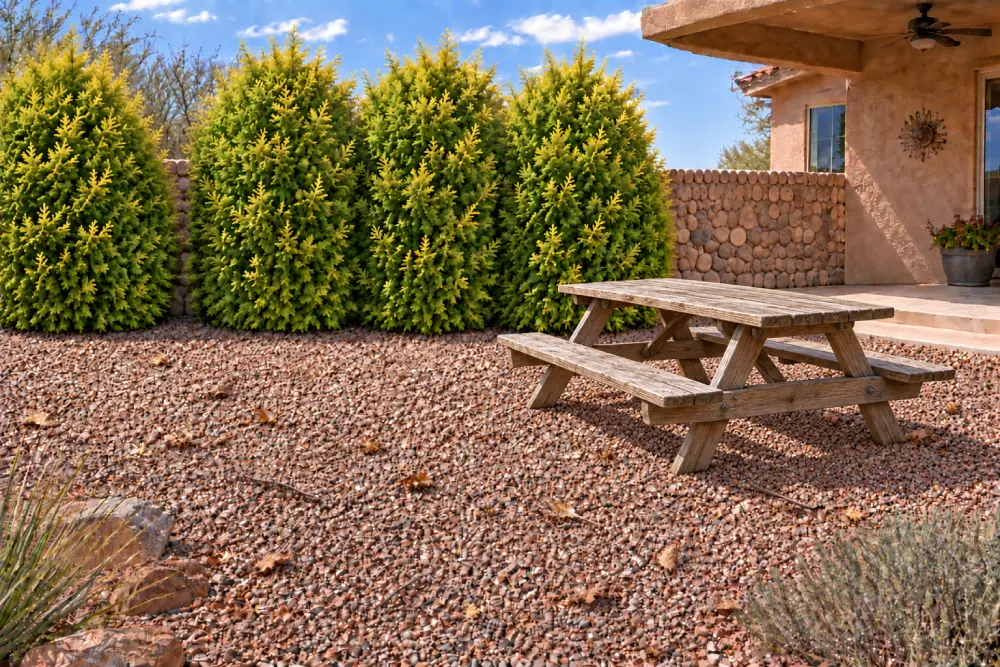
Dwarf Golden Arborvitae is one of the best choices for homeowners who want evergreen structure without planting a large privacy tree. It does well in the Southwest and brings bright golden-yellow foliage into the landscape.
Depending on the exact variety, Dwarf Golden Arborvitae usually develops a compact, rounded, oval, or slightly pyramidal shape. It commonly reaches about 4 to 6 feet tall and 3 to 5 feet wide, although mature size can vary.
Its golden foliage looks especially attractive when planted near dark-green shrubs, red landscape rock, rock walls, or Southwestern-style homes. The foliage may become more bronze during cold winter weather before brightening again in spring.
Dwarf Golden Arborvitae works well for:
- Home entrances
- Foundation plantings
- Courtyards
- Small backyard borders
- Accent plantings
- Decorative containers
- Low screens
- Adding color along border walls
Unlike Green Giant or Emerald Green, this variety is normally planted as an accent shrub rather than as a tall privacy screen. Several plants can be repeated along a wall, but leave enough space between them to show their natural shape.
Allow approximately 3 to 4 feet between plants, depending on the mature size of the variety. Plant them at least 2½ to 3 feet away from a wall whenever space allows.
Dwarf Golden Arborvitae tolerates our Southwestern sun, but some afternoon protection can help prevent the golden foliage from scorching during extreme heat. A location receiving morning sun and light afternoon shade is ideal. Too much shade, however, may cause the foliage to lose some of its bright golden color and become greener.
Water it deeply and consistently while it becomes established. Once established, it can tolerate brief dry periods, but it will still need regular irrigation during the hottest part of summer.
We normally carry Dwarf Golden Arborvitae year-round at Guzman’s Garden Centers, although availability and plant sizes may vary. It is a dependable choice for adding evergreen color to smaller areas where a full-size arborvitae would eventually become too large.
Using Arborvitae Along Border Walls
Many homes in Las Cruces and throughout the Southwest have concrete-block, stucco, or rock border walls. These walls provide privacy, but they can look bare and may not be tall enough to block a neighboring house or second-story window.
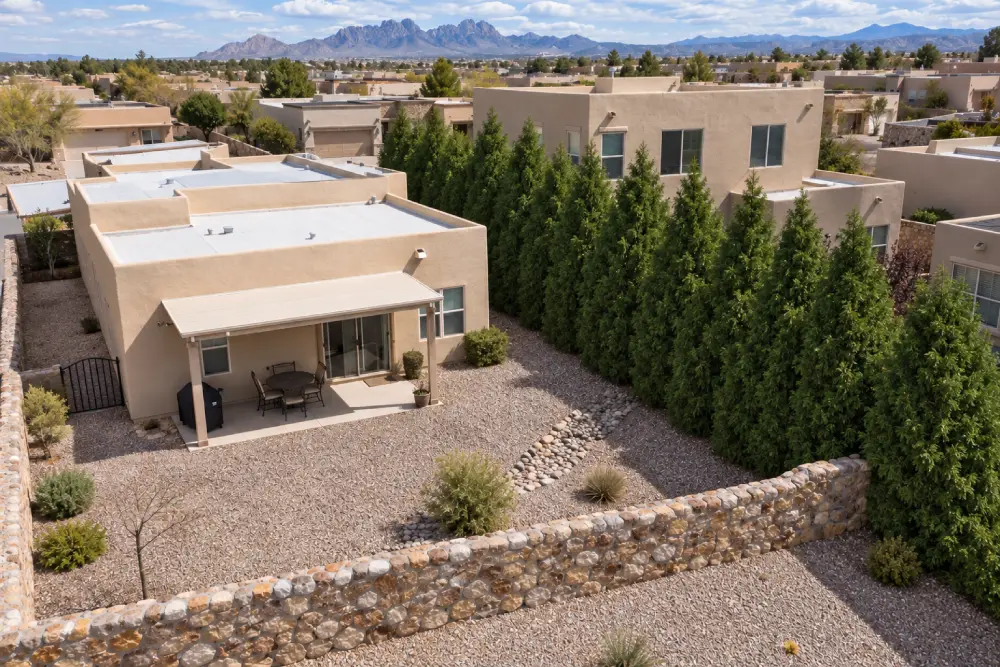
Arborvitae can soften the appearance of the wall while extending the visual screen above it. Their evergreen foliage provides privacy during winter as well as summer.
Before planting, pay attention to how much sunlight the wall receives. An east-facing wall is usually easier because it receives gentler morning sunlight. A west-facing wall can create extreme reflected heat during summer.
Do not plant arborvitae directly against the wall. A young plant may look fine in that location, but as it grows, the back side becomes crowded and difficult to maintain. Poor air circulation and uneven sunlight can also cause thin or bare spots.
Planting too close to a wall can cause:
- Flattened or uneven growth
- Constant pruning
- Reduced air circulation
- Dry soil caused by reflected heat
- Difficulty repairing or painting the wall
- Roots competing with nearby plants
The proper distance depends on the mature width of the variety. Dwarf Golden and Emerald Green need less room than Oriental Arborvitae or Green Giant.
Always look above the planting location for rooflines, power lines, and other obstacles. Green Giant arborvitae can eventually become a very tall tree and should never be planted underneath utility lines.
How to Plant Arborvitae in Southwestern Soil
Fall and early spring are the best times to plant arborvitae in the Southwest. Fall planting gives the roots time to begin establishing before the following summer. Avoid planting during periods of extreme heat whenever possible.
Dig the planting hole two to three times wider than the root ball but no deeper. The top of the root ball should be level with, or slightly above, the surrounding soil.
Do not bury the trunk or pile soil over the top of the root ball. Planting too deeply reduces oxygen around the roots and can cause slow decline or root rot.
Our native soil may contain clay, sand, rocks, or caliche. Improve drainage where necessary, but avoid filling the entire planting hole with rich compost or potting soil. This can encourage the roots to remain inside the amended hole instead of growing into the surrounding soil.
Backfill primarily with the soil removed from the hole. A modest amount of compost may be mixed into poor soil, but it should not replace most of the native soil.
Finish by creating a wide watering basin around the plant. Apply 2 to 3 inches of mulch over the root zone to conserve moisture and moderate soil temperature. Keep the mulch several inches away from the trunk.
Watering Arborvitae in the Southwest
Proper watering is the most important part of growing healthy arborvitae in our region.
Newly planted arborvitae have limited root systems and can dry out quickly. Water deeply immediately after planting and check the root ball regularly during the first several months.
The root ball and surrounding soil should remain moist but not constantly saturated. A quick spray from a garden hose is not enough. Water needs to penetrate deeply into the soil.
During the first summer, a newly planted arborvitae may need deep watering two or three times per week. The exact schedule depends on temperature, soil drainage, plant size, wind, and sun exposure. Sandy soil dries faster, while heavy clay soil holds moisture longer.
Once established, arborvitae should be watered deeply but less frequently. Do not depend on a lawn sprinkler to provide enough moisture. Drip irrigation or a slow-running hose around the root zone is usually more effective.
Move drip emitters outward as the plant grows. The active roots eventually spread beyond the original root ball, so keeping every emitter next to the trunk will not water the entire root system.
Continue checking arborvitae during winter. Evergreen plants lose moisture through their foliage throughout the year and may need winter irrigation during long dry periods.
Fertilizing and Pruning Arborvitae
Arborvitae normally do not require heavy fertilizing. Too much fertilizer can force fast, soft growth that is more vulnerable to heat and water stress.
If growth is weak or the foliage looks pale, consider testing the soil before applying fertilizer. Many Southwestern soil problems are related to high pH and poor nutrient availability rather than a complete lack of fertilizer.
If fertilizer is needed, apply a slow-release tree and shrub fertilizer in early spring. Always follow the product label and water thoroughly after application.
Light pruning can be done to maintain the plant’s shape or remove uneven growth. Avoid cutting deeply into old, bare wood. Arborvitae may not produce new foliage from a branch that no longer has green growth.
Green Giant and Emerald Green naturally maintain attractive forms. Oriental Arbor
New to Southwest Gardening?
Stop wasting money on plants that will not survive our heat and drought.
My Southwest Gardening Made Simple eBook shows you which trees, shrubs, flowers, and vegetables actually thrive in New Mexico, Arizona, and West Texas.
The best plants for hot, dry climates
Common mistakes that kill Southwest plants
Easy-to-follow advice for beginners

Paul Guzman is a lifelong Southwest gardener and gardening writer with decades of experience helping homeowners grow beautiful landscapes in the desert Southwest. He writes for Guzman’s Garden Centers in Las Cruces, New Mexico, with contributing expertise from Gary Guzman, owner of Guzman’s Garden Centers. If you have any questions or enjoyed this post, feel free to share your thoughts in the comments below.